

The UK’s Biggest Single Betting Event by the Numbers
No other race in the British calendar does what the Grand National does to betting volumes. I have spent nine years analysing horse racing markets, and the sheer scale of this single event still catches me off guard every April. Approximately 250 million pounds was staked on the 2025 Grand National — a figure that dwarfs the Cheltenham Gold Cup by a factor of seven. That is not a typo. Seven hundred percent more money flows through the Grand National market than through the most prestigious race in jump racing.
What makes that number even more striking is who is placing those bets. Around half of all Grand National stakes are five pounds or less, and roughly 30% of the people betting are either complete newcomers or punters who only surface once a year for this race. The Grand National is not just a sporting event — it is a national ritual that pulls in millions of people who do not normally engage with horse racing at all.
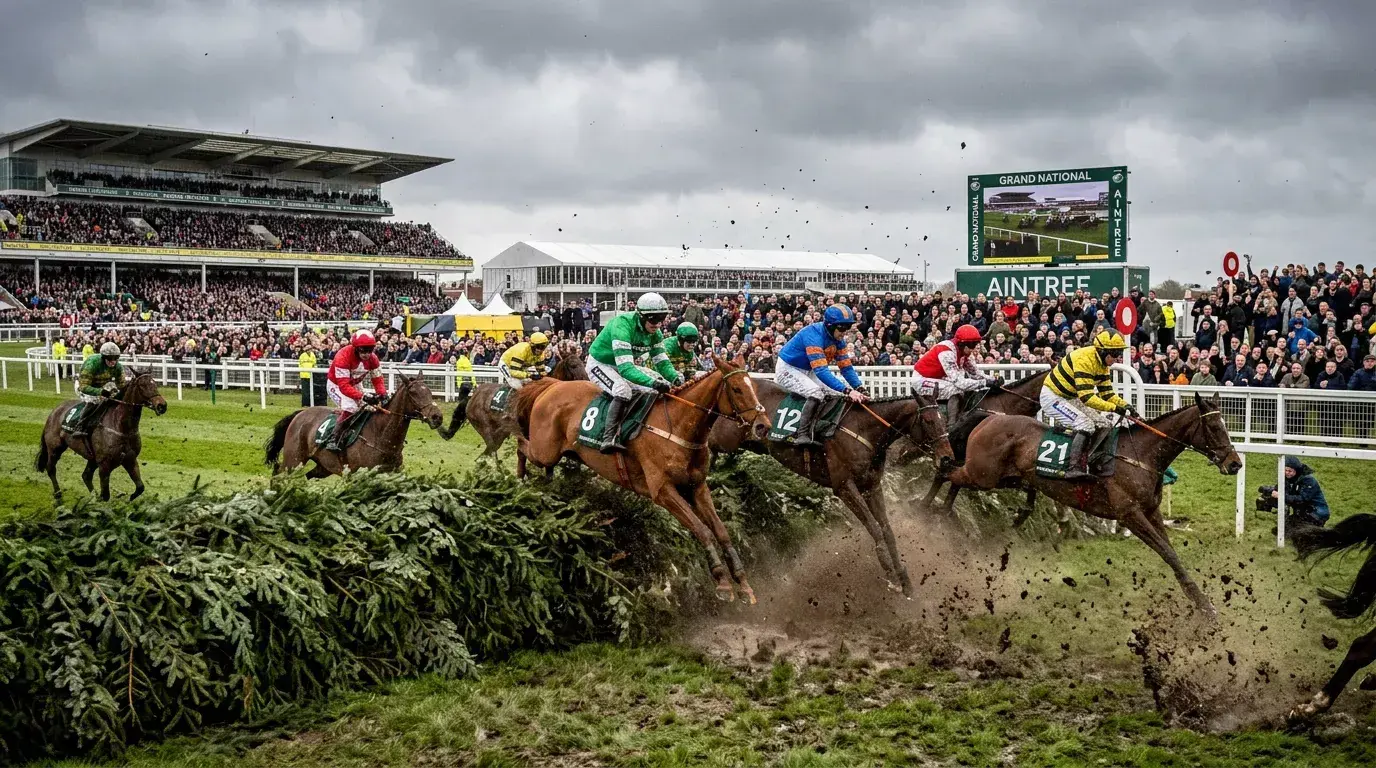
That creates a unique betting environment. The market is flooded with casual money, the field is typically 40 runners over four miles and two furlongs of the most demanding fences in jump racing, and the range of possible outcomes is enormous. For a serious punter, this combination of factors opens opportunities that do not exist in any other race on the calendar.
But it also means the market behaves differently from a standard Saturday handicap. Understanding those differences — where the money goes, how the odds form, and what strategies hold up against the data — is what separates a bet from a punt.
Grand National Odds Patterns: Favourites, Outsiders and Value Zones
I pulled together the results of every Grand National since 2000 and looked at where winners clustered in the betting. The pattern surprised me less than the consistency of it. Grand National winners overwhelmingly come from the 8/1 to 33/1 range. The outright favourite has won only a handful of times in the modern era, and genuine outsiders beyond 40/1 rarely trouble the finish — despite what your office sweepstake might suggest.
The reason is structural. A 40-runner handicap over extreme distance with 30 fences is designed to compress the field’s ability. The weights are set to give every horse a theoretical chance, and the obstacles add randomness that pure ability on the flat would not. That means the market’s favourite — the horse judged best on form — faces a barrage of variables that no amount of talent can fully overcome. Loose horses, fallers at key fences, the pace of the race in the early stages: all of these factors erode the favourite’s statistical edge.
Conversely, the extreme outsiders — the 100/1 shots that office syndicates love — almost never win because the Grand National, for all its chaos, still rewards fitness, jumping ability and race experience. Horses that are clearly outclassed do not survive four and a half miles of Aintree.
The value zone sits in between. Horses priced between 10/1 and 25/1 that have solid form over three miles or more, proven jumping credentials and decent course experience represent the intersection of realistic ability and attractive odds. In my records, this band produces more than half of all winners and an even higher share of placed horses — which matters enormously if you are betting each-way.
There is another angle worth watching: the late money. In the final hour before the off, the Grand National market can shift dramatically as professional money enters alongside a wave of last-minute casual bets. A horse that drifts from 14/1 to 20/1 in that window without any obvious negative news — no ground concern, no jockey change — is sometimes offering better value at the bigger price simply because the casual money has piled onto more fashionable names. I have found some of my best Grand National results by watching those late drifters rather than following the crowd.
Betting Strategy for the Grand National: Each-Way and Full Cover
If there is one race where each-way betting earns its reputation, it is the Grand National. Standard place terms on a field of 40 typically pay four places at one-quarter the odds, though many operators offer enhanced terms — five, six or even seven places — specifically for this race. Those enhanced place terms transform the maths of each-way betting.
Consider a horse at 20/1. A win-only five-pound bet returns 105 pounds if it wins and nothing if it finishes second through fortieth. An each-way bet at five pounds costs ten pounds total. If the horse wins, you collect on both the win part (105 pounds) and the place part (five pounds at 5/1 = 30 pounds), totalling 135 pounds from a ten-pound outlay. If it finishes in the places without winning, you collect 30 pounds on the place part — a 20-pound profit on your ten-pound stake. With enhanced terms paying six places, that safety net stretches even wider.
Full cover bets — combinations like Lucky 15s, Yankees or Patents — also suit the Grand National because of the field size and price range. A Lucky 15 across four selections in the 14/1 to 25/1 range needs just one horse to place for a return, and if two or more hit, the doubles, trebles and four-fold start multiplying. The risk, as always with full cover bets, is the total outlay: a one-pound Lucky 15 is 15 pounds, and a two-pound version is 30. But in a race where the result is notoriously hard to predict and the place terms are generous, spreading your risk across multiple selections in the value zone can be more effective than loading up on a single pick.
An estimated 9.4 million pounds of the Grand National’s 2025 turnover — about 3.8% — went to unlicensed operators. That is money bet outside the regulated market, with no payout guarantees and no contribution to racing through the levy. If you are going to bet on this race, do it through a licensed operator. The stakes are too high, in every sense, to take that risk.
