

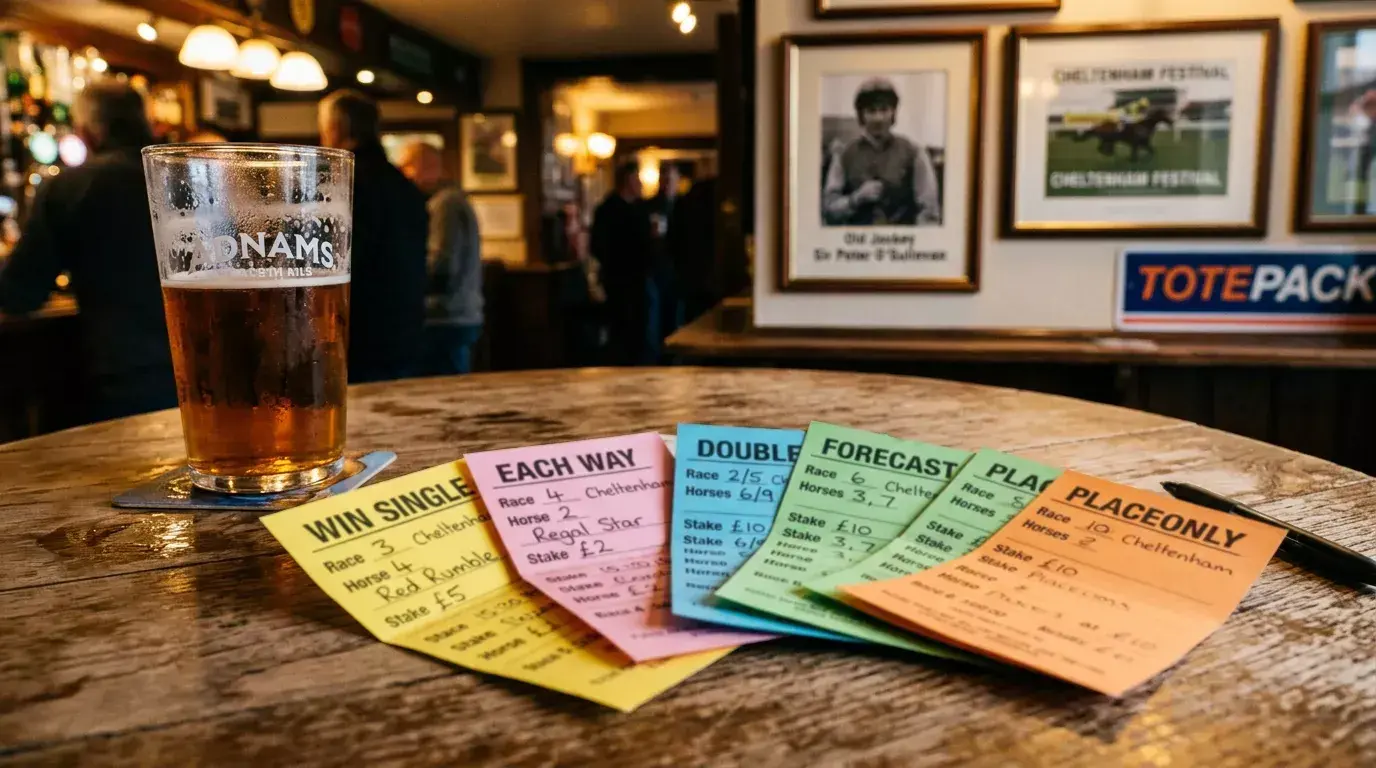
Market Coverage: Singles, Multiples and Pool Structures
A mate of mine once told me he had placed a “reverse forecast accumulator” on a Saturday card. I asked him to explain what that meant. He could not. He had seen the option on his betting app, tapped it because the potential return looked enormous, and handed over £20 without understanding the bet he was making. His horses ran well enough, but his bet lost, and he still does not know why.
That story is not unusual. UK bookmakers offer a dizzying array of bet types on horse racing — from the simplest win bet to elaborate full cover constructions involving dozens of separate wagers — and the majority of punters use only two or three of them while ignoring the rest entirely. Around 10.3% of UK adults bet on sport and racing online or through apps, and for most of them the bet slip is a tool they tap through on autopilot rather than a decision they consciously structure.
This guide covers every standard bet type available on UK horse racing markets, from singles through to full cover bets, pool betting and in-play options. I have organised them in order of complexity: start with the foundations, move through multiples and forecasts, and finish with the specialist structures. Each section explains the mechanics, the maths, and — critically — when the bet type makes strategic sense and when it does not. If you are already comfortable with win and each-way bets and want to jump straight to multiples or full cover bets, the headings will get you there.
Punters looking for full coverage across multiple selections often utilize the Lucky 15 bet structure to guarantee returns even if only one horse wins.
Win, Place and Each-Way: The Foundation Bets
Every bet type in horse racing is built on the win bet. You pick a horse, you stake your money, and if it finishes first you collect at the quoted odds plus your stake back. A £10 win bet at 6/1 returns £60 profit plus your £10 stake — £70 total. If the horse finishes anywhere other than first, you lose your stake. No partial payouts, no consolation, no complexity. The win bet is the purest expression of opinion in the market.
A place bet strips out the need to find the winner. Instead, your horse needs to finish in one of the designated place positions — typically the top two, three or four depending on the field size. Place odds are quoted independently and are shorter than win odds because the probability of placing is higher than the probability of winning. Not every bookmaker offers standalone place betting on every race, but it is widely available on the major meetings and on races with eight or more runners.
Each-way combines the two. It is two bets in one: a win stake and a place stake, each at the same amount. A £10 each-way bet costs £20 total. If the horse wins, both parts pay out. If it places but does not win, the place part pays at a fraction of the full odds — typically 1/4 or 1/5 depending on the race conditions. Each-way is the single most popular bet structure in UK horse racing for good reason: it offers a safety net on longer-priced selections where the place part alone can return a profit. The mechanics are more involved than most punters realise, particularly around place terms and breakeven thresholds, and I would encourage anyone who uses each-way regularly to study the calculations properly before staking.
For the beginner, I would always recommend starting with win bets. They are simple, the expected return is transparent, and they force you to commit to an opinion rather than hedging across multiple outcomes. Once you are comfortable with win bets and understand how odds translate into implied probability, each-way becomes a natural progression for races where the field size and price justify the doubled stake.
Doubles, Trebles and Accumulators: How Multiples Build Returns
The moment you link two or more selections into one bet, you enter the world of multiples — and the maths changes dramatically. A double is the simplest multiple: two selections, both must win for the bet to pay out. Your return from the first winner rolls onto the second selection as the stake. If you back Horse A at 3/1 and Horse B at 4/1 in a double, the combined odds are (3+1) x (4+1) – 1 = 19/1. A £5 double returns £100 if both win. If either loses, you get nothing.
A treble adds a third selection. All three must win. The compounding effect is seductive: three horses at 3/1 each produce combined odds of (4 x 4 x 4) – 1 = 63/1. A £2 treble returns £128. The headline figures look spectacular on the betting slip, which is exactly why bookmakers prominently feature accumulators in their app interfaces. The reality is that the probability of all three winning at true 3/1 odds is 25% x 25% x 25% = 1.56%. You will lose this bet roughly 98 times out of 100.
An accumulator extends the chain to four selections (a four-fold), five (a five-fold), or more. Each additional leg multiplies the potential return and simultaneously slashes the probability of success. A six-fold at average odds of 3/1 per selection carries combined odds of approximately 4,095/1 and a win probability of 0.024%. I am not saying accumulators are worthless — they have a place as low-stake entertainment bets — but treating them as a strategy is a fast route to an empty bank. The overround compounds across every leg, and by the time you reach a five-fold the bookmaker’s built-in margin has grown from a manageable 10-15% on a single race to a structural disadvantage that no amount of skill can consistently overcome.
One nuance: each-way accumulators exist and they soften the all-or-nothing structure. In an each-way accumulator, the place parts of your selections compound separately from the win parts. If three of your four selections place but only two win, you still collect on the place accumulator. The returns are smaller but the frequency of collection is higher, which can make each-way accumulators a more sustainable approach than win-only multiples on big festival days where placed horses at decent prices are plentiful.
Forecasts and Tricasts: Predicting the Exact Finish
Forecasts and tricasts ask you to predict the exact finishing order, not just the winner. They are harder to land than win bets, but when they do land the returns can be extraordinary — particularly in big-field handicaps where the placed horses are long-priced.
A straight forecast requires you to name the first and second horse in the correct order. Horse A first, Horse B second. If they finish the other way round, you lose. A reverse forecast covers both permutations — A first and B second, or B first and A second — but costs twice the stake because it is effectively two straight forecasts combined. Forecast dividends are calculated based on a computer model (the Computer Straight Forecast, or CSF) that reflects the starting prices of the two horses. The less likely the combination, the higher the dividend. A forecast combining a 3/1 favourite and a 5/1 second favourite might return 15/1 or 20/1. A forecast linking two 20/1 outsiders in a 16-runner handicap can return hundreds to one.
A tricast extends the concept to three horses: first, second and third in exact order. The probability drops sharply and the dividends rise accordingly. A combination tricast covers all six possible orderings of your three selections, at six times the unit stake. Tricasts are only available on races with eight or more runners and, like forecasts, they pay a computer-calculated dividend rather than a fixed price.
I use forecasts selectively, primarily in handicaps where I have a strong view on two or three horses but limited confidence in which one will actually win. A combination forecast on three horses costs six units (three permutations of two from three) and gives me coverage across the top two finishing positions regardless of order. The expected value calculation is more opaque than on a win bet — because the CSF dividend is not known until after the race — but when the selections are at bigger prices and the field is competitive, the structural payout tends to compensate for the lower strike rate.
Full Cover Bets: Trixie, Patent, Yankee, Lucky 15 and Beyond
Full cover bets are the Swiss army knife of multiples — every possible combination of your selections bundled into one bet. They cost more upfront but they pay out even if not all of your horses win, which is the fundamental appeal over a straight accumulator.
The Trixie is the simplest: three selections generating four bets — three doubles and one treble. If two of your three selections win, you collect on one double. If all three win, you collect on all three doubles and the treble. The minimum return requires two winners. A Trixie at £1 per line costs £4.
A Patent adds three singles to the Trixie: three singles, three doubles, one treble — seven bets total. The advantage over a Trixie is that a single winner returns something. At £1 per line, a Patent costs £7. If your only winner is a 10/1 shot, the single returns £11 — enough to cover the £7 outlay and produce a small profit. That safety net does not exist in a Trixie.
The Yankee scales up to four selections: six doubles, four trebles, one four-fold — eleven bets. A Lucky 15 adds four singles to that: fifteen bets total. The Lucky 15 is the most popular full cover bet in UK racing, partly because many bookmakers offer consolation bonuses on it — typically double odds on the single if only one horse wins, and a percentage bonus if all four win. For a detailed worked example of how the 15 bets are structured and how consolation terms apply, I have a dedicated piece on the Lucky 15 in horse racing.
Beyond the Lucky 15 sit the Canadian (five selections, 26 bets), Heinz (six selections, 57 bets), Super Heinz (seven selections, 120 bets), and the Goliath (eight selections, 247 bets). Each step up multiplies the number of bet lines and the total stake. A £1 Goliath costs £247. The potential returns on a Goliath where all eight selections win at decent prices run into the tens of thousands, but the probability of that outcome is vanishingly small. In practice, these exotic full cover bets are entertainment constructions rather than strategic tools. I have never placed a Goliath in my life, and I do not plan to start. Roughly £250 million is wagered on the Grand National alone each year, and the vast majority of that is concentrated in singles and each-way bets rather than elaborate full cover structures.
Tote and Pool Betting: How It Differs From Fixed-Odds
Everything I have described so far operates on fixed odds: you take a price, and if you win, the bookmaker pays out at that price. Pool betting works differently. Your stake goes into a collective pool with every other bettor’s money, the pool operator takes a percentage deduction, and the remaining pot is divided among the winners. The odds are not set by a bookmaker — they are determined by how many people backed each outcome.
The Tote is the UK’s pool betting operator for horse racing. Its core products are the Win pool (pick the winner), the Place pool (pick a placed horse), the Exacta (first and second in order), the Trifecta (first, second and third in order), and the Jackpot (pick the winner of six consecutive races). The most distinctive Tote product is the Placepot: pick a horse to place in each of the first six races on a card, with a minimum stake of £1. Placepot dividends vary enormously — from a few pounds to several hundred — depending on the difficulty of the results and the number of winning tickets.
Pool dividends are published after each race as a return to a £1 stake. A Win pool dividend of £8.40 means a £1 winning stake returns £8.40 including the stake. The dividend can be higher or lower than the equivalent fixed-odds SP, which creates occasional value for punters who follow the pool markets. On busy racing days when attendance is high — UK racecourse attendance exceeded 5.031 million in 2025 — the on-course Tote pools are larger, which tends to produce dividends closer to the SP. On quieter days, thinner pools can produce either generous or poor dividends relative to fixed odds.
The levy yield reached a record £108.9 million in 2024-25, and pool betting contributes to that figure through its own deduction structure. Gráinne Hurst of the Betting and Gaming Council has pointed to the paradox of “record levy contributions” alongside falling turnover, noting that racing “continues to struggle, both as a sport and as a betting product.” Pool betting remains a niche within the broader market, but the Placepot in particular has a devoted following among punters who enjoy the communal, shared-dividend aspect of the bet.
In-Play Betting on Horse Racing: What Is Available
In-play betting on horse racing is more limited than in-play on football or tennis, for an obvious reason: horse races are short. A typical flat race lasts between one and three minutes. A long-distance National Hunt chase might stretch to seven or eight minutes. That compressed timeframe leaves a narrow window for in-play wagering, and most bookmakers offer in-play markets only on selected televised races rather than across the entire card.
Where in-play is available, the bet types are usually restricted to win and place markets. The odds update in real time based on a combination of the live picture and algorithmic pricing models. If the favourite stumbles at the second-last fence in a steeplechase, its in-play odds lengthen instantly, and the odds on the horses behind it shorten. The speed of these movements means that latency — the delay between what is happening on the track and what you see on your screen — is a genuine issue. A bet placed on a stream that runs three to five seconds behind reality is a bet placed on stale information.
Online GGY for the final quarter of 2024-25 rose 7% year-on-year to £1.45 billion, with average monthly active accounts reaching 13.5 million. In-play betting is a growing component of that figure, though the Gambling Commission does not break out in-play horse racing as a separate category. My view is that in-play horse racing betting is best treated as a specialist tool rather than a default approach. It suits punters who watch every race live, who understand pace scenarios, and who can react to visual information faster than the pricing algorithm adjusts. For everyone else — and that includes me on most days — the pre-race market is where the value lives.
Which Bet Type Suits Your Strategy and Bankroll
Knowing what every bet type does is one thing. Knowing which one to use on a given day is the skill that separates strategic punters from habitual ones. The answer depends on three variables: your bankroll, your confidence level, and the race conditions.
If your bankroll is modest — say, £200 for the month — singles and each-way bets are the only sensible options. They give you the highest number of individual bets per pound wagered, which means more data points to evaluate your method and more chances to find a return. A £200 monthly budget buys forty £5 win bets or twenty £5 each-way bets. Either approach gives you a statistically meaningful sample over a few months. Splitting that same £200 into four £50 accumulators gives you four lottery tickets and no useful information about your selection ability.
If you have a larger bankroll and a strong view on multiple races on the same card, a Trixie or Patent can extract additional value from those views without the all-or-nothing risk of an accumulator. The key is that every selection in the full cover bet must independently represent value. Adding a weak third selection to a Patent just to “have a bet” in the third race dilutes the entire structure, because the doubles and treble now carry an anchor that drags down the expected return.
Forecasts and tricasts suit experienced punters who study form deeply enough to have an opinion on finishing order, not just the winner. They work best in competitive handicaps with big fields where the CSF dividends are generous and where your form study gives you an angle on two or three horses that the market is not pricing accurately.
Half of all Grand National stakes are £5 or less, placed by occasional bettors who engage with the sport once or twice a year. For that audience, an each-way single on a horse whose name they like is perfectly fine — it is a recreational bet on a recreational occasion, and the expected loss is the price of entertainment. But if you bet regularly and you are serious about your returns, the bet type you choose is a strategic decision, not a default setting. Match it to the race, match it to your bank, and match it to the strength of your opinion. Everything else is noise.
Explore comprehensive market data and pricing analysis directly on the RAILFORM homepage.
