

UK Horse Racing Market: Industry Turnover and Regulation
I placed my first horse racing bet in 2017 — a tenner each-way on a 14/1 shot at Newbury that finished fourth by a neck. I lost money that day, but I gained something more useful: a fascination with the sheer depth of data this sport generates. Nine years later, that fascination has turned into a career spent analysing UK racing markets, and the landscape I work in now barely resembles the one I started with.
The UK is not just a major horse racing betting market — it is the largest regulated one on the planet. The numbers confirm it. In the financial year ending March 2025, the entire UK regulated gambling industry generated gross gambling yield of 16.8 billion pounds, up 7.3 per cent year on year. The online segment alone — remote casino, betting and bingo combined — accounted for 7.8 billion pounds of that total, a jump of over 900 million pounds in a single year. Within that vast online ecosystem, remote horse racing betting contributed 766.7 million pounds in GGY, making it the second-largest remote betting vertical after football.
Those figures should stop you in your tracks. Horse racing betting in the UK is not a niche hobby bolted onto a bigger gambling machine. It is an industry that funds the sport itself, employs tens of thousands of people across the racing ecosystem, and touches the lives of over 10 per cent of British adults who bet on sport and racing through apps and websites. The racing industry's direct revenues exceed 1.47 billion pounds annually, with a total economic contribution — including induced effects — of 4.1 billion pounds and roughly 85,000 jobs.
Market context: Horse racing is the UK's second-largest spectator sport by attendance and its second-largest online betting vertical by GGY. The market is backed by over a century of regulatory infrastructure, a statutory levy system that funds the sport, and a level of data transparency unmatched anywhere in the world.
Yet the market is under pressure. Betting turnover on British races has been falling for three consecutive years. Regulatory changes — particularly affordability checks introduced in February 2025 — have reshaped how punters interact with licensed operators. A growing black market of unlicensed sites is siphoning revenue from the regulated ecosystem. Understanding all of this matters, whether you are placing your first bet or your ten-thousandth.
This guide covers UK online horse racing betting in 2026: how the market works, what types of bets are available, how pricing mechanisms function, what regulation means for your account, and how to approach the sport strategically. Every claim is grounded in a specific figure.
What 766 Million Pounds in Racing Revenue Actually Means for Punters
- UK online horse racing betting generated 766.7 million pounds in gross gambling yield in FY2024-25 — second only to football — yet actual betting turnover per race is falling year on year, down 10.7 per cent since 2023.
- Affordability checks now trigger at 150 pounds in net deposits per month, affecting nearly a quarter of active bettors and driving a 522 per cent surge in traffic to unlicensed sites.
- Best Odds Guaranteed remains the single most valuable feature for racing punters — it costs you nothing and automatically upgrades your payout when the Starting Price exceeds your early price.
- Strategic betting requires a staking plan, a record of every bet, and the discipline to only act when the odds imply a probability lower than your own assessment. Value is a mathematical concept, not a feeling.
- From April 2027, horse racing bets will be taxed at 15 per cent — ten points below the new 25 per cent rate for other remote gambling — a carve-out designed to protect the sport's economic ecosystem.
The Numbers Behind UK Horse Racing Betting
A few years ago, I sat in a press room at Cheltenham and listened to a racing executive describe the sport's finances as "robust." The journalist next to me muttered, "Robust compared to what?" It is the right question. The headline numbers in UK horse racing betting look enormous — until you start breaking them down by direction of travel.
Start with the big picture. Online channels drove the UK gambling market's growth in FY2024-25, generating 7.8 billion pounds in GGY — a 13.1 per cent rise, now representing 46 per cent of the total market. The shift from physical to digital is no longer a trend. It is the reality.
Horse racing sits as the second-largest remote betting vertical. The 766.7 million pounds in remote racing GGY trails football's 1.3 billion pounds but dwarfs every other sport. The total remote betting vertical across all sports was 2.6 billion pounds, meaning horse racing alone accounts for nearly 30 per cent of online sports betting revenue.
UK Regulated Gambling GGY
16.8 billion pounds (FY2024-25), up 7.3% year on year
Online Segment GGY
7.8 billion pounds — 46% of total market
Remote Horse Racing Betting GGY
766.7 million pounds — second only to football
Monthly Active Online Accounts
13.5 million average (Q4 FY2024-25), up 2% year on year
Racing's Economic Contribution
4.1 billion pounds annually, supporting approximately 85,000 jobs
But here is where the narrative shifts. Despite rising GGY, actual betting turnover on British horse races has been falling. The cumulative turnover for 2025 came in 4.3 per cent below 2024 and 10.7 per cent below 2023. Average turnover per race dropped 5.6 per cent year on year and 11.6 per cent compared with 2023. Richard Wayman, the BHA's Director of Racing, acknowledged the decline directly: total betting turnover fell nine per cent in Q1 2025 alone compared with the same period in 2024, with average turnover per race at Core Fixtures down 14.4 per cent.
How can GGY rise while turnover falls? The answer is margin. Bookmakers are retaining a higher percentage of each pound wagered — partly through market structure, partly through the sheer volume of short-priced favourites winning at everyday meetings, and partly because the mix of bettors is changing. Smaller-staking recreational punters, who tend to bet at worse odds and on popular selections, now make up a larger share of the customer base as higher-staking punters face restrictions. The overall pool of money being bet is shrinking, but the operators' cut of that pool is growing.
Racecourse attendance topped 5.031 million in 2025 — the first time the figure crossed five million since before the pandemic. Average attendance per meeting rose 3.6 per cent to 3,526. The sport has never been more popular in person, even as its betting revenues contract.

The Horserace Betting Levy — a statutory 10 per cent charge on bookmaker GGY from British racing — reflects this paradox. Levy yield hit 108.9 million pounds in FY2024-25, the highest figure since 2017. Record levy, falling turnover. As Grainne Hurst, CEO of the Betting and Gaming Council, put it: contributions have increased to record levels for the fourth year running, demonstrating the growing long-term investment regulated betting provides British horse racing — but it is concerning that despite record levy contributions, racing continues to struggle both as a sport and as a betting product, with betting turnover down again year on year.
Online Versus High-Street: Where the Money Flows Now
I grew up walking past a William Hill on my way to school. The shop is a vape store now. That anecdote is the industry in miniature.
The number of licensed betting shops in the UK has fallen to 5,825 as of March 2025 — a 36 per cent decline over ten years and the eleventh consecutive year of contraction. In-shop GGY for Q4 FY2024-25 slipped three per cent year on year to 554 million pounds, while online GGY for the same quarter rose seven per cent to 1.45 billion pounds.
Online Betting
GGY Q4 FY2024-25: 1.45 billion pounds (+7% YoY). Active accounts: 13.5 million monthly average. Growth driver: mobile apps and in-play markets. Share of total market: 46% and climbing.
High-Street Betting Shops
GGY Q4 FY2024-25: 554 million pounds (-3% YoY). Shop count: 5,825 (-36% over decade). Decline driver: footfall loss, FOBT stake cap, demographic shift. GGY trend: from 3.3 billion pounds in 2015-16 to 2.5 billion pounds in 2023-24.
The migration is structural, not cyclical. HM Treasury consultation data shows in-shop GGY fell from 3.3 billion pounds in 2015-16 to 2.5 billion pounds in 2023-24, while online betting GGY climbed from 1.7 billion to 2.4 billion over the same period.
For punters, this shift matters in practical terms. Online operators offer Best Odds Guaranteed, live streaming of races, cash-out functionality, and a depth of in-play markets that no shop counter can replicate. The trade-off is that the online environment is where affordability checks, account restrictions, and identity verification processes are most keenly felt. The convenience is real. So are the friction points.
Core Bet Types Every Punter Should Understand
When I started analysing racing markets, I assumed most punters stuck to simple win bets. I was wrong. A quick look at customer data from any major festival reveals a kaleidoscope of bet types — singles, each-ways, accumulators, forecasts, full-cover bets — each with its own risk profile and its own mathematical DNA. The Gambling Survey for Great Britain puts the participation figure at 10.3 per cent of adults betting on sport and racing online, with men three times more likely than women. That is millions of people navigating a menu of options every day.
The foundation is straightforward. A win bet pays out only if your selection finishes first. An each-way bet is two bets in one: the first on the win, the second on your horse finishing in a specified place position — typically the top two, three, or four depending on field size and race type. The place part pays at a fraction of the win odds, usually one quarter or one fifth. Each-way betting is so central to UK racing culture that I have written a complete guide to how each-way bets work, including place terms tables and worked return calculations.
Win Bet — the simplest wager in horse racing: you back a single horse to finish first. If it wins, you collect the odds price multiplied by your stake, plus your stake returned. If it loses, you lose the stake.
Each-Way Bet — two bets in one. The win part pays if the horse finishes first. The place part pays if the horse finishes within the specified number of places (e.g. top 3 in a field of 8-15 runners), at a fraction of the win odds. Your total outlay is double a single stake.
Accumulator — a single bet that links two or more selections across different races. All selections must win for the bet to pay out. Odds compound with each leg, creating large potential returns — and proportionally large risk.
Forecast — a bet on two horses to finish first and second in a specified order (straight forecast) or in either order (reverse forecast). A tricast extends this to first, second and third in exact order.
Example: A simple win bet at fractional odds
| Element | Value |
|---|---|
| Stake | 10 pounds |
| Odds taken | 5/1 |
| Horse wins | Profit = 10 x 5 = 50 pounds |
| Total return | 50 + 10 stake = 60 pounds |
| Horse loses | Loss = 10 pounds |
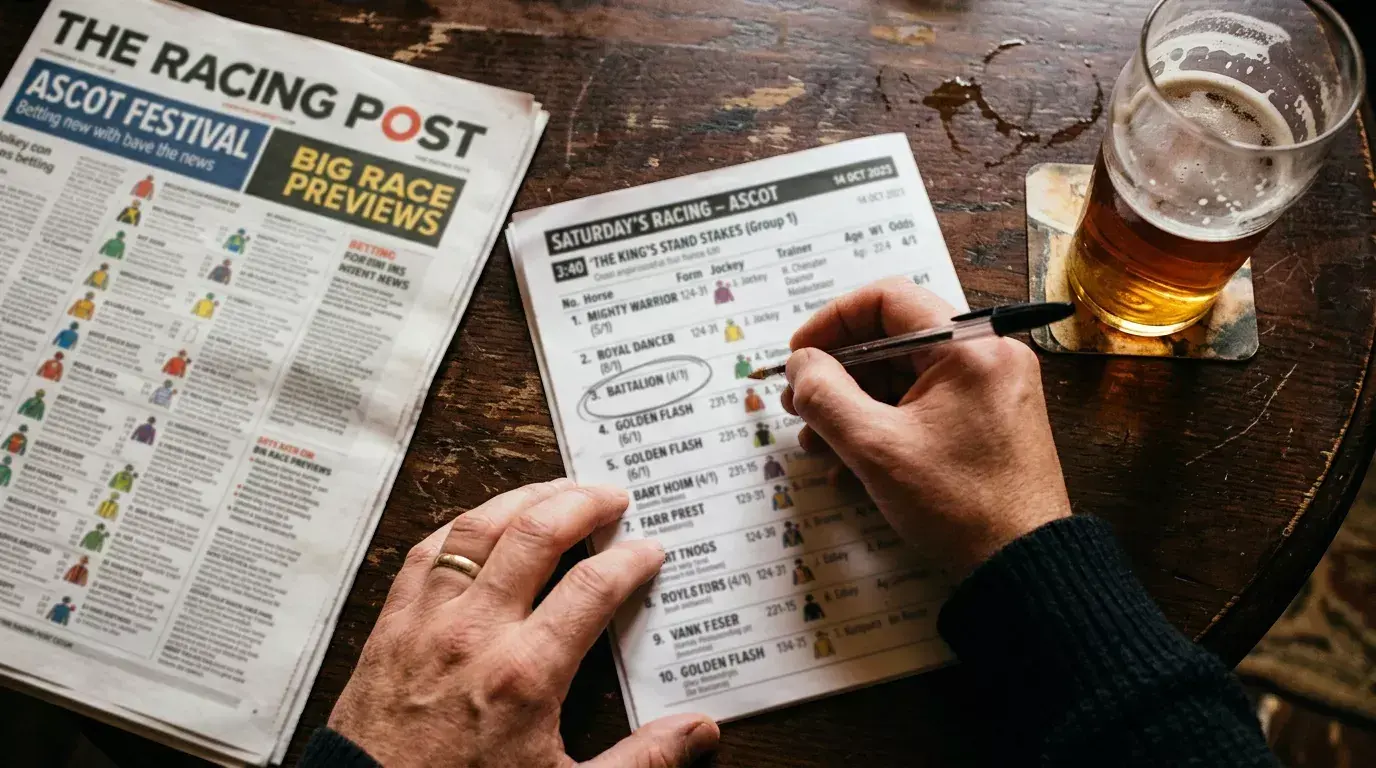
Understanding the mechanics is essential, but understanding when to use each bet type matters more. A win bet at 5/1 on a horse you rate at 4/1 is a value proposition. An each-way bet on that same horse in a 20-runner handicap might offer even better expected returns if the place terms are generous. For a thorough breakdown of every option available — from singles to Goliaths — see the full guide to horse racing bet types.
Multiples, Forecasts and Full Cover Bets
Full-cover bets are where horse racing wagering gets genuinely interesting — and where I see the most misunderstanding among even experienced punters.
A Trixie covers three selections with four bets: three doubles and one treble. A Patent adds three singles on top of that, giving you seven bets total. Scale up to four selections and you get the Yankee (11 bets: six doubles, four trebles, one four-fold) or the Lucky 15 (15 bets: the Yankee plus four singles). The Lucky 15 is particularly popular at festivals because many bookmakers offer consolation bonuses if only one selection wins — typically double the odds on that winner — and enhanced payouts if all four land.
Lucky 15 structure — 4 selections, 15 bets
Selections: Horse A, Horse B, Horse C, Horse D
4 singles: A, B, C, D
6 doubles: AB, AC, AD, BC, BD, CD
4 trebles: ABC, ABD, ACD, BCD
1 four-fold: ABCD
At 1 pound per bet, total outlay = 15 pounds. If only Horse A wins at 8/1, the single returns 9 pounds. With a typical consolation bonus (double odds), the single returns 17 pounds — covering more than the total stake.
Forecasts and tricasts operate differently. Rather than linking outcomes across races, they ask you to predict the exact finishing order within a single race. A straight forecast requires first and second in order. A combination forecast allows either order but doubles the stake. A tricast demands first, second and third in exact sequence — and the payouts can be dramatic in big-field handicaps where the correct combination might yield returns of several hundred pounds from a small stake.
The key principle across all multiples is that risk compounds with complexity. Each additional leg multiplies your potential return but also multiplies the probability of failure. I keep coming back to a simple rule: if you cannot articulate a specific reason for each selection in a multiple — beyond "the odds look good together" — you are gambling on compound luck, not making a reasoned bet.
Best Odds Guaranteed and Starting Price: How Pricing Works
I backed a horse at Ascot last summer at 8/1 in the morning. By the time the gates opened, the Starting Price had drifted to 12/1. Because the operator offered Best Odds Guaranteed, I was paid at 12/1 — a 50 per cent improvement on my original price without any additional action on my part. That single mechanism, BOG, has saved me more money over nine years than any staking plan or system I have ever tested.
What is Starting Price (SP)? The Starting Price is the official odds of a horse at the moment the race begins, determined by on-course bookmakers' boards. It serves as the default settlement price for bets where no fixed odds were taken. SP is calculated independently of online operators — it reflects the balance of money at the racecourse itself.
Best Odds Guaranteed is simple in concept: if you take an early price on a horse and the SP at the off is higher, the bookmaker pays you at the better price. If the SP is lower, you keep the price you originally took. You win either way. In practice, this means BOG acts as a free insurance policy. You lock in a price you are happy with, and if the market moves in your favour, you benefit automatically.
Best Odds Guaranteed (BOG)
You take a price early. If SP is higher at the off, you receive the higher SP. If SP is lower, you keep your original price. Available at most major UK operators on UK and Irish racing. Restrictions: often capped at a maximum payout (e.g. 500 pounds extra winnings), may not apply to ante-post bets, and some operators exclude certain meetings.
Starting Price (SP)
You accept whatever the SP will be when the race starts. No early price advantage. No price improvement. SP is determined by on-course bookmakers. Useful when you cannot monitor markets or when you expect the price to shorten. No cap on SP payouts. SP is the default for telephone and on-course bets.
When does BOG matter most? In big-field handicaps where late market moves are common. At festivals like Cheltenham and Royal Ascot where gambled horses can drift dramatically on the day. In any race where you have identified value at an early price and want protection against further drift. For a deep dive into the mechanics, restrictions and worked payout examples, the full guide to Best Odds Guaranteed covers every scenario.
The flip side is that BOG is a marketing tool. Operators offer it because the customer acquisition benefit outweighs the cost of honouring price improvements. That does not reduce its value to you, but it does mean you should check the terms. Some operators cap the maximum extra winnings. Some exclude early-morning prices or specific meetings. The feature is nearly universal among major UK operators for UK and Irish racing, but the small print varies.
Betting Strategy in a Data-Driven Era
Every January I sit down with a spreadsheet and calculate my previous year's return on investment. Some years it is positive. Some years it is not. But the exercise itself is the strategy — because the moment you stop measuring, you stop improving, and the market eats you alive.
The turnover data I outlined earlier tells the wider story. In a market where betting volume per race is declining year on year and higher-staking punters are being squeezed by affordability checks, the recreational bettor who bets without structure is donating to the bookmaker's margin. The punters who survive a contracting market are the ones with a disciplined approach — and discipline starts with measuring everything.
Do
- Define a staking plan before you place your first bet of the season — level stakes, percentage of bankroll, or a Kelly-based approach — and stick to it
- Record every bet with date, race, selection, odds taken, SP, result and running profit/loss
- Compare your struck prices against SP over a rolling 100-bet sample to check whether you are consistently beating the market
- Treat each race as an independent event — yesterday's losses do not make today's bet more "due"
Don't
- Chase losses by doubling stakes after a bad day — this is the single fastest route to bankroll destruction
- Bet on every race on the card — selectivity is the core skill
- Ignore the implied probability embedded in the odds — a 3/1 shot implies a 25 per cent chance, and if you do not believe the true probability is higher, there is no value
- Confuse a short winning streak with a validated strategy — you need a minimum of several hundred bets to draw meaningful conclusions
The gap between recreational betting and strategic betting comes down to one concept: value. A value bet exists when the odds offered by the market imply a probability lower than the true probability of the horse winning. Finding value consistently requires three things — an opinion on each horse's true chance, the discipline to only bet when the price exceeds that opinion, and the patience to endure losing runs without abandoning the method. I have covered the mathematics and practical application of this approach in the dedicated horse racing betting strategy guide, including staking models, form analysis workflows and seasonal adjustments.
Strategy begins with understanding the odds, but it sharpens when you can read the data underneath them — form figures, going conditions and the signals the market sends in the minutes before a race.
Reading Form, Going and Market Signals
I have a rule I apply to every race I assess: if I cannot explain in one sentence why a horse's recent form fits this specific race, I do not bet. That sentence forces me to consider the factors that actually predict outcomes — course suitability, distance preference, ground conditions, class level and trainer intent.
Going — the official description of ground conditions at a racecourse, ranging from firm (dry, fast surface) through good, good to soft, soft, and heavy (waterlogged, stamina-sapping). The going is the single most variable factor in UK racing, capable of transforming a horse's chance from favourite to no-hoper between the overnight stage and the off.
Form Figures — the shorthand history of a horse's recent results, read left to right with the most recent run last. "1" means a win, "2" means second, "0" means finished outside the top nine, "P" means pulled up, "F" means fell, "U" means unseated rider. A slash "/" separates different seasons.
Headgear — equipment applied to manage a horse's behaviour: blinkers restrict peripheral vision, cheekpieces partially obscure it, a visor shields the eyes from kickback, a hood covers the ears to reduce noise distraction. First-time headgear is a significant market signal — it often indicates a trainer trying something new to improve a horse's focus.
Form analysis in UK racing is both an art and a data exercise. The raw figures on a racecard tell you what happened. The job of a strategic bettor is to ask why it happened and whether those conditions will repeat today. A horse with the form line 1-3-2 looks solid — but if those runs were all on good ground and today's going is heavy, the picture changes entirely. Horses in training in the UK numbered 21,728 in 2025, down 2.3 per cent on the previous year, continuing a multi-year decline in the horse population. Fewer horses mean smaller fields in many races, which compresses odds and reduces each-way value — another reason why reading form carefully, rather than simply backing names, has become more important.
Market signals add another layer. A horse whose price shortens from 10/1 in the morning to 6/1 at the off is being backed by serious money — possibly informed money from connections who know the horse is ready to run a big race. A horse drifting from 4/1 to 8/1 may be facing market doubt about fitness, the going or the draw. I do not treat market moves as gospel — plenty of gambled horses lose — but I do treat sudden, sharp moves as data points worth incorporating alongside form and conditions.
Major UK Racing Events and Their Betting Markets
The Grand National is not just a horse race. It is a national conversation. Around 250 million pounds was wagered on the 2025 running — roughly 700 per cent more than the Cheltenham Gold Cup, making it comfortably the single biggest betting event in the UK calendar. What makes that figure even more striking is the composition: approximately 50 per cent of Grand National stakes are five pounds or less, and around 30 per cent of the bettors are either complete newcomers or people who only bet once a year.
Grand National
Aintree, Liverpool. April. Up to 40 runners over 4 miles and 2.5 furlongs. Approximately 250 million pounds in betting turnover. The ultimate each-way race: typically pays four or more places.
Cheltenham Festival
Cheltenham, Gloucestershire. March. Four days, 28 races. The defining National Hunt meeting. Ante-post markets open months in advance. Levy yield spikes around Cheltenham results due to bookmaker margin volatility.
Royal Ascot
Ascot, Berkshire. June. Five days, 35 races. The flagship flat meeting. Big-field handicaps on the final days offer draw bias, going variance and some of the most competitive betting heats of the year.
Epsom Derby
Epsom Downs, Surrey. June (first Saturday). The blue riband of flat racing. Ante-post market active from the previous autumn. Unique camber and undulations make the track a specialist test.
Glorious Goodwood
Goodwood, West Sussex. Late July/early August. Five days. Known for extreme draw biases on certain courses and large-field handicaps that reward punters who study the track geometry.
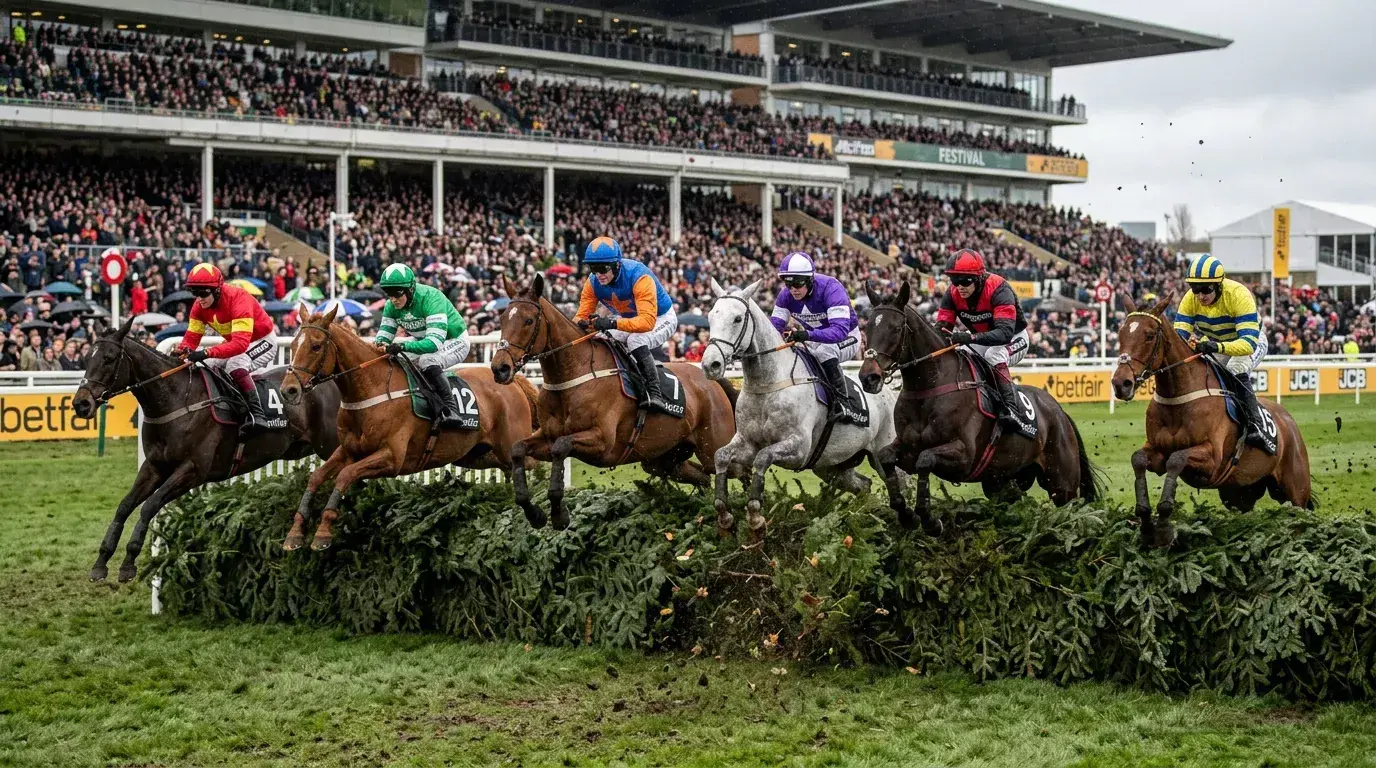
Each of these events creates a distinct betting market. The Grand National's enormous field and its unique obstacles mean that ante-post markets carry higher risk — non-runner refunds are not standard for ante-post bets, and the attrition rate in the race itself is significant. Cheltenham's four-day format creates cascading market effects: a strong performance by a trainer or jockey on day one can reshape the betting for the rest of the week. Royal Ascot's flat racing is data-rich — speed figures, draw statistics and going adjustments are more quantifiable than in jumps racing, which makes it a particular favourite for analysts.
Grainne Hurst, CEO of the Betting and Gaming Council, has called the Grand National one of the precious few sporting events in this country with the ability to unite the entire nation around a single spectacle. The data supports the claim: no other British race generates anything close to its betting volume, and the demographic profile of its bettors — heavily skewed towards once-a-year participants — is unique in UK sport.
Seasonality matters for your betting calendar. The flat season runs roughly from April to October, peaking around Royal Ascot and Glorious Goodwood. The National Hunt season dominates from October through April, with Cheltenham as its crescendo and the Grand National as its curtain call. Betting participation reflects this directly: participation in the four weeks to July 2025 was seven per cent of the adult population, nearly double the four per cent recorded in adjacent survey waves.
Regulation, Affordability Checks and What They Mean for You
In February 2025, the Gambling Commission lowered the trigger for affordability checks from 500 pounds to 150 pounds in net deposits per month. That single regulatory change has reshaped the relationship between UK bettors and licensed operators more profoundly than anything I have seen in nine years of covering this market.
Key threshold: If your net deposits — money deposited minus money withdrawn — exceed 150 pounds in a calendar month, your operator may initiate a "frictionless" affordability check using credit reference agency data. If your net deposits exceed higher thresholds or if the initial check raises flags, enhanced checks requiring documentation such as bank statements or payslips can follow.
The Gambling Commission maintains that 95 per cent of the 530,000 checks conducted passed frictionlessly through credit agency data, requiring no direct action from the bettor. That is the regulator's headline. The industry's headline is different. The Racing Post's Big Punting Survey — roughly 10,000 respondents — found that 23.7 per cent of bettors had been subjected to affordability checks in 2025, up from 16.6 per cent in 2023. Among higher-staking punters, a third admitted to using unlicensed operators. A separate YouGov survey found that 65 per cent of British bettors were unwilling to hand over personal financial documents to continue betting.
Richard Wayman put the consequences plainly: the decline in betting revenue is primarily driven by the impact of affordability checks, which push people either to stop betting entirely or to bet with unlicensed operators. The numbers support him. Online horse racing betting turnover dropped by 1.6 billion pounds since 2022, and when adjusted for inflation, the real deficit stands at roughly 3 billion pounds — a figure the industry has taken to calling the "black hole" in racing's finances. The Jockey Club estimates that affordability checks could cost British racing 250 million pounds over five years through reduced betting turnover alone.
What this means for you: If you are a recreational bettor depositing under 150 pounds per month across all your accounts, you are unlikely to be directly affected. If you are a regular punter with higher monthly activity, you should expect some form of check — most likely automated and invisible, but potentially requiring documentation. This is the current regulatory reality, and it applies to every UKGC-licensed operator.

The black market consequences are measurable. Traffic to unlicensed websites accepting bets on British horse racing surged 522 per cent between August 2021 and September 2024. An estimated 9.4 million pounds of Grand National 2025 turnover went through unlicensed operators. These sites pay no tax, contribute nothing to the levy, offer no safer gambling protections, and provide no guarantee that winning bets will be honoured. For a detailed breakdown of the process and its impact, see the full affordability checks guide.
The 2027 Tax Reform and Racing's Special Rate
April 2027 reform: The UK government will introduce a 25 per cent tax rate on all remote gambling from April 2027, replacing the current patchwork of duties. However, remote bets on horse racing will be taxed at 15 per cent — a deliberate carve-out recognising racing's unique economic structure and its dependence on betting revenue through the levy system.
This carve-out is not a minor detail. Independent modelling commissioned by the BHA found that a uniform 21 per cent rate — let alone 25 per cent — would have cost the racing industry approximately 66 million pounds per year and potentially destroyed 2,752 jobs. The 15 per cent rate means that operators' margins on horse racing bets will be less compressed than on other sports, which should in theory protect the incentive to offer competitive odds and maintain features like BOG on racing markets.
Whether the carve-out survives beyond the initial legislation is an open question. Parliamentary debates on gambling regulatory reform have been frequent. Ian Murray, the DCMS Minister, stated directly that if someone is operating in the illegal market, the government is coming after them — legislatively, regulatorily and with money — referencing the 26 million pounds allocated to the Gambling Commission for black market enforcement. The regulatory landscape is evolving, and punters who stay informed will be better positioned than those who do not.
How to Choose a Licensed Betting Operator
Twice in the past three years, I have had an account restricted by a major operator within weeks of opening it. Not because I did anything wrong — because I won consistently. Account restrictions are a fact of life in UK online betting, and they are a factor in how you should choose where to place your money.
The non-negotiable starting point is licensing. Every operator you use must hold a valid licence from the UK Gambling Commission. There are 5,825 licensed betting shops and a much larger number of licensed online operators — but "licensed" is a legal baseline, not a quality endorsement. You should verify any operator's licence status directly on the UKGC's public register before depositing funds. A licence means your funds are segregated, your disputes have a formal resolution channel, and the operator is subject to regulatory oversight on fairness, responsible gambling and advertising standards.
Do
- Verify the UKGC licence on the public register before opening any account
- Check whether the operator offers Best Odds Guaranteed on UK and Irish racing — and read the specific terms, including any payout caps
- Test the live streaming quality and coverage during a midweek afternoon meeting before relying on it for festival betting
- Compare cash-out availability and speed — some operators suspend cash-out on racing markets more frequently than others
- Open accounts with multiple licensed operators to maintain access if one restricts your account
Don't
- Choose an operator solely on the strength of a welcome offer — the long-term value of BOG and competitive odds far outweighs a one-time free bet
- Deposit with any operator that is not listed on the UKGC register, regardless of how attractive the odds or promotions appear
- Ignore the affordability check thresholds — if you plan to deposit regularly, understand that 150 pounds in net deposits per month triggers the first check tier
- Assume that all operators offer the same markets — depth of ante-post coverage, exotic bet types and international racing coverage varies significantly

Beyond licensing, the features that matter most are BOG, live streaming, depth of ante-post markets, cash-out functionality, and the operator's track record on account management. An operator that offers every feature but restricts your account after three winning weeks is less useful than one with slightly less generous terms that lets you bet freely for years. The 13.5 million average monthly active accounts across the industry confirm there is no shortage of choice — make that choice on substance, not on which welcome banner is flashiest.
Flat Season, Jumps Season and Betting Seasonality
UK horse racing does not have an off-season in the way football or cricket does, but it absolutely has rhythms — and understanding those rhythms will improve your betting.
Flat Racing
Season: April to October (turf); all-weather runs year-round. No obstacles. Distances: 5 furlongs to 2 miles. Emphasis on speed, draw and going. Key events: the Guineas, Epsom Derby, Royal Ascot, Glorious Goodwood, York Ebor, Champions Day. Betting profile: generally smaller fields at the top level, bigger fields in handicaps. Data-rich: speed figures, sectional times and draw statistics are more readily available.
National Hunt (Jump) Racing
Season: October to April (though some summer jumps). Hurdles and steeplechases. Distances: 2 miles to 4 miles+. Emphasis on stamina, jumping ability and ground conditions. Key events: Cheltenham Festival, Grand National, King George VI Chase. Betting profile: larger fields in handicaps, high attrition rates (fallers, pulled-up), ante-post markets more volatile due to injury and ground uncertainty.
The seasonality shows up directly in participation data. Betting on horse racing in the four weeks to July 2025 reached seven per cent of the adult population — the peak — compared with four per cent during January-to-April and July-to-October waves. Festival periods drive engagement, and the overlay of the flat and jumps calendars in April and October creates some of the busiest betting weeks of the year. If you are building a bankroll management plan, factoring in these natural peaks and troughs — rather than trying to maintain the same level of activity year-round — will help you allocate stakes more effectively across the calendar.
Frequently Asked Questions
Is online horse racing betting legal in the UK?
Yes. Online horse racing betting is fully legal in the UK provided the operator holds a valid licence from the UK Gambling Commission. You must be 18 or over to place a bet. The UKGC maintains a public register where you can verify any operator's licence status before opening an account. Betting with unlicensed operators is not illegal for the punter, but it offers no regulatory protection — your funds are not segregated, you have no access to a formal disputes process, and there are no safer gambling safeguards in place.
What is Best Odds Guaranteed and how does it work?
Best Odds Guaranteed means that if you take a fixed price on a horse and the Starting Price at the off is higher, the bookmaker pays you at the higher SP. If the SP is lower than the price you took, you keep your original price. It applies to UK and Irish racing at most major operators, though terms vary — some cap the maximum additional payout, some exclude specific meetings, and it typically does not cover ante-post bets. BOG is effectively a free upgrade mechanism: you cannot lose from it, only gain.
What is each-way betting in horse racing?
An each-way bet is two bets in one: a win bet and a place bet on the same horse. The win part pays if the horse finishes first. The place part pays if the horse finishes within a specified number of positions — usually top two in fields of five to seven runners, top three in fields of eight to fifteen, and top four in handicaps of sixteen or more. The place part is paid at a fraction of the win odds, typically one quarter or one fifth depending on the race. Your total stake is double a single bet — a 10-pound each-way bet costs 20 pounds.
What are the biggest UK horse racing events to bet on?
The five major betting events are the Grand National at Aintree in April (the largest single betting event in the UK, with around 250 million pounds wagered), the Cheltenham Festival in March (four days of championship National Hunt racing), Royal Ascot in June (the flagship flat meeting), the Epsom Derby in June (flat racing's blue riband), and Glorious Goodwood in late July. Each event has distinct betting characteristics: the Grand National attracts once-a-year punters with big-field each-way opportunities, while Cheltenham and Ascot draw serious ante-post and in-play markets.
What do horse racing odds tell you about a horse's chances?
Odds represent the market's assessment of probability. Fractional odds of 5/1 mean the market implies a roughly 16.7 per cent chance of winning (calculated as 1 divided by 6). Decimal odds of 6.0 convey the same information. The total implied probability across all runners in a race will exceed 100 per cent — the difference is the bookmaker's overround, which is their built-in margin. Understanding implied probability is the foundation of value betting: if you believe a horse has a 25 per cent chance but the odds imply only 16.7 per cent, the price offers value.
What is the difference between flat racing and jump racing for betting?
Flat racing involves no obstacles, covers distances from five furlongs to two miles, and runs primarily on turf from April to October with year-round all-weather fixtures. Jump racing (National Hunt) involves hurdles or steeplechase fences, covers two miles to four miles and beyond, and runs mainly from October to April. For bettors, the key differences are: flat racing produces more predictable results with lower attrition rates, while jump racing involves fallers, pulled-up horses and greater ground sensitivity. Flat form data tends to be more quantifiable (speed figures, sectional times), whereas jump racing rewards assessment of jumping ability and stamina on testing ground.
Do I pay tax on horse racing betting winnings in the UK?
No. UK residents pay no tax on gambling winnings, including horse racing. The tax burden sits entirely with the operators. Since 2001, punters have been exempt from betting duty. From April 2027, operators will pay 25 per cent on remote gambling GGY across most sports, with horse racing receiving a reduced rate of 15 per cent due to its economic structure and the levy system. The tax reform does not change anything for punters — your winnings remain tax-free regardless of the amount.
