

Each-Way Mechanics: Place Terms and Field Size Rules
I placed my first each-way bet on a 14/1 shot at Newbury in 2017. The horse finished third, and I remember staring at my betting slip wondering whether I’d won anything at all. I had — the place part returned a tidy profit — but it took me an embarrassingly long time to work out exactly how much. That confusion is universal. Each-way is the single most popular bet type in UK horse racing, yet half the punters I speak to cannot explain how the place payout is calculated.
The appeal is straightforward: you get two chances from one selection. Back a horse each-way and you collect if it wins, but you also collect if it finishes in the places — typically the top two, three or four depending on the field size. It is the default bet type for the Grand National, where casual punters want a safety net on big-priced runners, and it is equally popular with seasoned racegoers working through a full festival card.
Each-way is not a single bet. It is two bets, charged at two separate stakes. That distinction matters because it doubles your outlay and changes the maths of when it is and is not good value. Over the next few thousand words I will break down the mechanics, the place terms, and the return calculations in enough detail that you never have to squint at a betting slip again. I will also flag the mistakes I still see experienced punters making — mistakes that cost real money across a season.
If you are brand new to the different wager structures available, it helps to see each-way in context alongside singles, multiples and forecasts. But each-way deserves its own deep dive, because the place terms alone can swing a bet from excellent value to a poor proposition.
How an Each-Way Bet Works: Win Part and Place Part
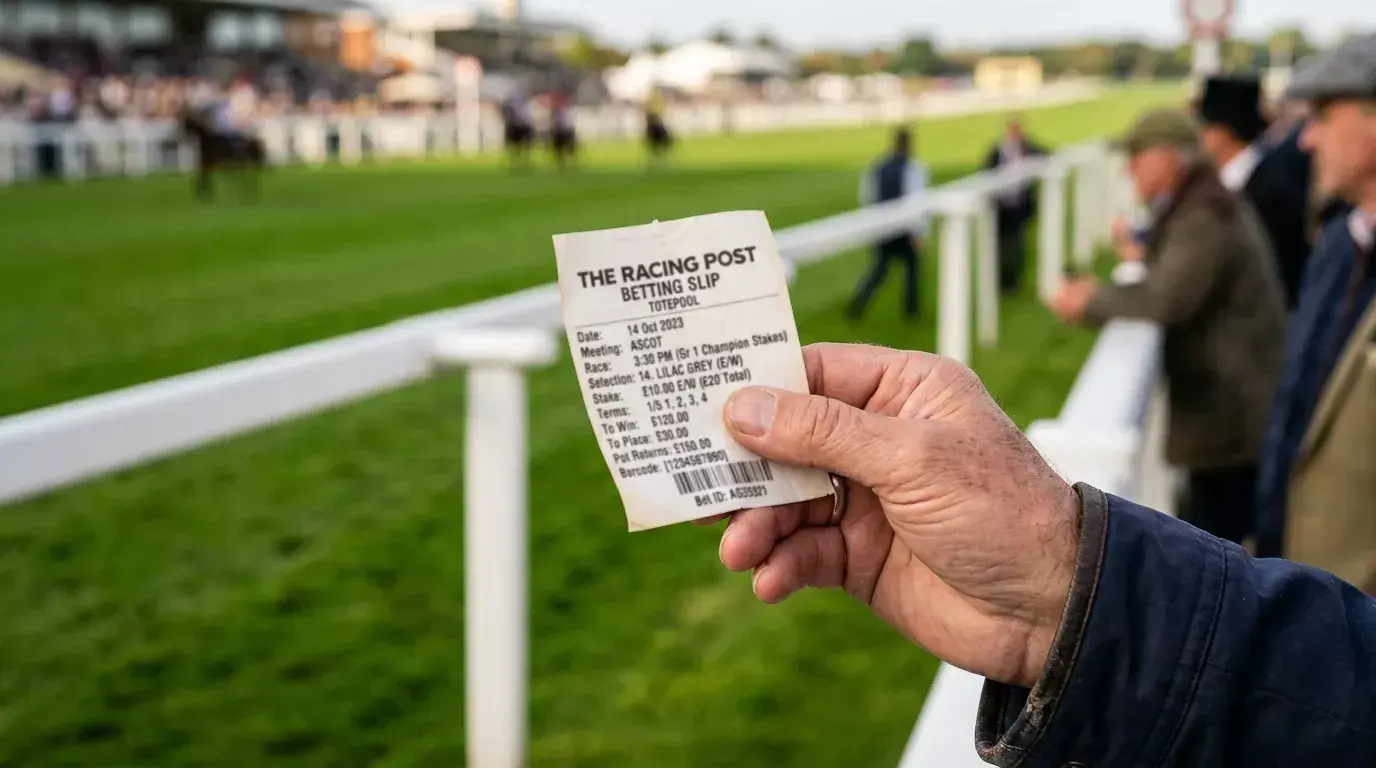
Strip away the jargon and an each-way bet is just two separate wagers bundled under one name. The first wager — the win part — pays out only if your horse finishes first. The second wager — the place part — pays out if the horse finishes in one of the allocated place positions, which includes first. You stake the same amount on each part, so a “£10 each-way” bet actually costs £20: £10 on the win, £10 on the place.
This is where most beginners trip up. They budget £10 for an each-way bet and then discover £20 has left their account. Every time. Without exception. If someone tells you they placed a £10 each-way bet, they spent £20. Get that fact lodged in your head now and everything else follows.
The win part is simple: horse wins, you collect at full odds plus your stake back. If you back a horse at 8/1 for £10 and it wins, you receive £80 profit plus your £10 stake — £90 total on the win part alone. But you also win the place part, because first is always a qualifying place position. The place part pays at a fraction of the full odds, determined by the place terms (more on those in the next section). At standard 1/5 odds, the place part would pay £16 profit plus your £10 stake — £26. Your total return on a winning each-way bet at 8/1 would be £90 + £26 = £116, from a £20 outlay.
Now the scenario that makes each-way attractive: your horse finishes second or third but does not win. The win part loses — that £10 is gone. The place part pays out. At 8/1 with 1/5 odds, your place return is £26 on a £20 total outlay, so you have a £6 net profit despite your horse not winning. That is the cushion each-way provides, and it is why the bet dominates festival racing where big-field handicaps produce plenty of placed horses at decent prices.
One more subtlety: the place fraction applies to the odds, not to the total payout. At 8/1 with 1/5 odds, the place odds are 8/5 — which is 1.6/1. You do not receive one-fifth of the full win return. You receive the payout at one-fifth of the odds. The distinction is small at short prices but significant at longer ones, so make sure the maths is clear before moving on.
Before confirming your slip, always double-check the specific horse racing place terms offered by the bookmaker for that particular field size.
Place Terms by Field Size: 1/4 Odds vs 1/5 Odds
The number of places paid and the fraction of odds used for the place part are not universal — they shift depending on the race. I have seen punters back a horse each-way in a five-runner race and then express genuine shock when the bookmaker tells them only two places are available. The place terms are governed by field size, and they are non-negotiable on standard terms.
Here is how it works for the vast majority of UK horse racing markets. In races with two to four runners, most bookmakers do not offer each-way betting at all — it is win only. With five to seven runners, two places are paid at 1/4 of the odds. With eight or more runners in non-handicap races, three places are paid at 1/5 of the odds. In handicap races with twelve to fifteen runners, three places are paid at 1/4 of the odds. And in handicaps with sixteen or more runners, four places are paid at 1/4 of the odds.
The difference between 1/4 odds and 1/5 odds is not trivial. Take a horse at 10/1. At 1/4 odds, the place payout is 10/4 — that is 2.5/1, returning £25 profit on a £10 place stake. At 1/5 odds, the place payout drops to 10/5 — that is 2/1, returning £20 profit on the same stake. Five pounds less, from the same horse at the same price, just because the terms changed. Over a hundred bets across a season, that gap compounds into hundreds of pounds.
The practical takeaway: each-way betting offers better structural value in large-field handicaps, where you get four places at 1/4 odds, than in small non-handicap races where two places at 1/4 odds is the ceiling. Festival handicaps — the Coral Cup at Cheltenham, the Royal Hunt Cup at Ascot, the Grand National itself — are the natural habitat for each-way bets. Small-field Group 1s with six runners and 1/4 odds on only two places require a much more selective approach.
A word on enhanced place terms. Bookmakers frequently offer extra places as promotions, especially on big races. A 20-runner handicap that normally pays four places might be advertised as paying five or six. These promotions genuinely increase the expected value of an each-way bet, but read the small print — enhanced terms often come with restrictions on minimum odds or maximum stakes. For a complete breakdown of how standard and enhanced terms interact, I have a dedicated piece on place bet terms in horse racing.
Calculating Each-Way Returns Step by Step
Numbers settle arguments. I am going to walk through three scenarios step by step so you can see exactly how the returns stack up. Grab a calculator if you want to follow along — the maths is not difficult, but it does need to be precise.
Scenario 1: Horse wins at 12/1 in a 16-runner handicap
Terms: 4 places, 1/4 odds. Your stake: £10 each-way (£20 total). Win part: 12/1 x £10 = £120 profit + £10 stake = £130. Place part: 12/4 = 3/1 x £10 = £30 profit + £10 stake = £40. Total return: £130 + £40 = £170. Net profit: £170 – £20 outlay = £150.
Scenario 2: Horse finishes third at 12/1 in the same race
Win part: loses. You forfeit the £10 win stake. Place part: 3/1 x £10 = £30 profit + £10 stake = £40. Total return: £40. Net profit: £40 – £20 outlay = £20. You backed a horse that did not win and still turned a £20 profit. That is the beauty of each-way in big fields at double-digit prices.
Scenario 3: Horse finishes second at 3/1 in an 8-runner non-handicap
Terms: 3 places, 1/5 odds. Your stake: £10 each-way (£20 total). Win part: loses. Place part: 3/5 x £10 = £6 profit + £10 stake = £16. Total return: £16. Net profit: £16 – £20 outlay = -£4. You placed, but you lost money. At short prices with 1/5 terms, an each-way bet on a horse that does not win frequently returns less than your total outlay.
That third scenario is the one most punters never calculate in advance. There is a breakeven threshold — the minimum odds at which an each-way bet on a placed-but-not-winning horse returns at least your full stake. With 1/5 odds, that breakeven is 5/1. Anything shorter and a place without a win costs you money. With 1/4 odds, the breakeven drops to 4/1. Knowing these thresholds by heart saves you from placing each-way bets that are structurally incapable of producing a profit on the place alone.
For longer prices the maths tilts dramatically in your favour. A 25/1 shot finishing third in a 16-runner handicap at 1/4 terms returns 25/4 = 6.25/1 on the place part: £62.50 profit on a £10 place stake, or £72.50 total — a £52.50 net profit on a £20 outlay, from a horse that never threatened the winner. This is why each-way betting at festivals and big Saturday handicaps has sustained generations of profitable punters. The edge is structural, not speculative.
Each-Way Value at Major Festivals: Cheltenham, Ascot, Aintree
Cheltenham in March, Aintree in April, Royal Ascot in June — these three weeks produce more each-way opportunities than the rest of the calendar combined. I plan my entire each-way approach around them, and I think any serious punter should do the same.
Take the Grand National. Roughly £250 million is wagered on a single race, and the field typically features 40 runners. Standard terms pay four places at 1/4 odds, but bookmakers regularly extend that to five, six, even seven places to attract casual bettors. In a 40-runner handicap where most horses are priced between 16/1 and 50/1, the place part of an each-way bet carries enormous standalone value. A 33/1 shot finishing sixth with seven places paid at 1/4 odds returns 33/4 = 8.25/1 on the place — £82.50 profit on a £10 place stake. The race attracts an audience far beyond the regular punting community: half of all Grand National stakes are £5 or less, and around 30% of bettors are newcomers or returning after a long gap. Each-way is the default bet for these occasional punters, and the big operators know it.
Cheltenham operates differently. The fields are smaller — typically 10 to 24 runners depending on the race — but the quality is elite and the markets are sharper. The value in each-way at Cheltenham lies not in huge fields but in the volatility of National Hunt racing. Novice hurdles and bumpers regularly produce placed horses at 14/1 or longer. The Gambling Commission data confirms that the Cheltenham Festival generates disproportionate levy yield relative to its fixture count, which tells you the turnover per race is massive. Bigger turnover means more money in the market, which can create briefly mispriced each-way opportunities before the off.
Royal Ascot brings the flat season’s biggest handicaps. The Royal Hunt Cup, Wokingham and Buckingham Palace Stakes routinely feature 20-plus runners, giving you four places at 1/4 odds as standard. Attendance across UK racecourses topped 5.031 million in 2025, and Ascot’s five-day meeting accounts for a disproportionate chunk of that figure. More people through the gates means more on-course money in the pools, which can move prices late. If you are betting each-way on a 20/1 shot and the SP drifts to 25/1, a Best Odds Guaranteed policy hands you the bigger price on both the win and place parts — a double uplift that most punters do not even register.
My rule for festival each-way betting is simple: target races with 16+ runners where at least five of your longlist are priced 14/1 or bigger. In those conditions the structural advantage of 1/4 odds across four places is at its peak, and you do not need to find the winner to have a profitable day.
You can find more data-driven insights and daily market trends on our online horse racing betting platform.
Common Each-Way Mistakes and How to Avoid Them
Nine years of analysing horse racing bets and I still catch myself drifting toward the same traps. Each-way is forgiving in structure but punishing if you ignore the underlying maths. Here are the errors I see most often, including a couple I have committed myself.
The first and most expensive mistake is backing short-priced favourites each-way. If a horse is 2/1, the place part at 1/5 odds pays 2/5 — that is £4 profit on a £10 place stake. Your total return on a placed-but-not-winning horse is £14, against a £20 outlay. You lose £6 every time the favourite finishes second or third. Plenty of punters do this at Cheltenham on the Champion Hurdle favourite, reasoning that each-way gives them “insurance.” It does not. At those odds the insurance costs more than it is worth. Each-way should be reserved for selections where the place part alone can return your total stake, and as I mentioned earlier, that means minimum 5/1 at 1/5 terms or 4/1 at 1/4 terms.
The second mistake is ignoring field size before placing the bet. I spoke with a punter at Ascot last summer who had backed a horse each-way at 10/1 in what he thought was a 12-runner race. One horse was withdrawn after the overnight declaration stage, dropping the field to seven runners. The terms switched from three places at 1/5 odds to two places at 1/4 odds. His horse finished third. Under the original terms, he would have collected. Under the revised terms, third did not count. Non-runners can shift place terms, and the only defence is checking the confirmed runners before the market closes.
Third: doubling up on each-way in small fields because “I fancy two of them.” In a seven-runner race paying two places, backing two horses each-way costs four units and covers two of seven possible place finishers. The probability maths rarely justifies that outlay unless both selections are 8/1 or longer. Cumulative betting turnover on UK racing has dropped by over 10% since 2023 — punters cannot afford to burn stakes on structurally weak propositions. Richard Wayman, the BHA’s Director of Racing, has noted that turnover per race in the fixture programme’s core meetings fell by 14.4% in the first quarter of 2025 compared to the same period a year earlier. The market is tightening. Discipline on bet selection matters more now than at any point in the past decade.
Fourth: confusing each-way with “place only.” Some bookmakers offer place-only betting as a separate market, particularly on big races. The odds and terms differ from the place part of an each-way bet. Place-only odds are quoted independently and may be more or less generous than the each-way fraction. They are not interchangeable, and assuming they are will cost you.
Dead Heats and Rule 4 Deductions in Each-Way Bets
Dead heats and Rule 4 deductions are the two curveballs that catch even experienced each-way punters off guard. Neither is common, but both can significantly reduce your return.
A dead heat occurs when two or more horses cannot be separated on the finish line for a place position. If your horse dead-heats for third place in a race paying three places, the bookmaker settles the place part at half your stake. The calculation: take the place odds, work out the full return, then halve the profit and return half the stake. On a £10 place stake at 3/1 place odds, a dead heat for the final place position returns (£30 / 2) + (£10 / 2) = £15 + £5 = £20, instead of the £40 you would have collected without the dead heat. The win part is unaffected if your horse won outright.
Rule 4 deductions apply when a horse is withdrawn after the market has opened but before the race. Because the remaining horses’ true odds should be shorter without that competitor in the field, a percentage deduction is applied to all payouts. The scale runs from 5p in the pound for a 14/1 or longer withdrawal up to 90p in the pound for an odds-on withdrawal. Rule 4 applies to both the win and place parts of an each-way bet. If you backed a horse at 10/1 each-way and a 3/1 shot is withdrawn, triggering a 25p Rule 4 deduction, your win payout drops by 25% and your place payout drops by 25%. On a winning £10 each-way bet at 10/1, that 25p deduction strips £25 from the win part and £5 from the place part — £30 in total vanishing from a return you had already mentally banked.
Neither dead heats nor Rule 4 deductions are avoidable. They are structural features of the market. The only protection is awareness: know that they exist, understand how they affect your return, and factor them into your staking on races where late withdrawals or tight finishes are plausible. Big-field handicaps — the very races where each-way thrives — are also the races most prone to both scenarios.
