

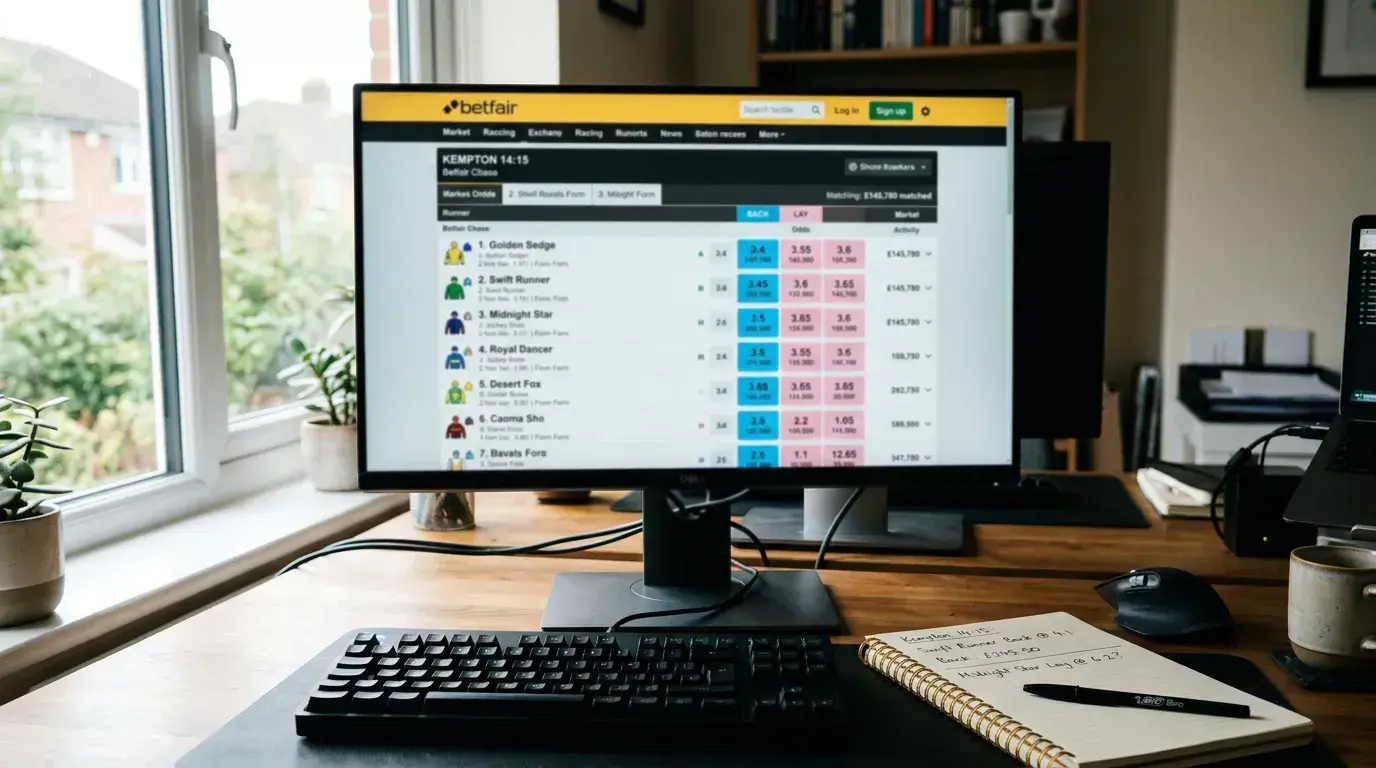
Exchange Betting: Why Laying a Horse Is Not the Same as Bookmaking
The first time someone explained lay betting to me, I misunderstood completely. I thought laying a horse meant I was running a book, taking on all the risk, essentially becoming a bookie. It took a losing trade on a 2/1 shot to teach me the difference. Laying a horse on an exchange is a specific, bounded transaction between two individuals. You are not offering odds to the world — you are matching a bet with one other person, and the exchange facilitates the process.
Remote horse racing betting generated 766.7 million pounds in gross gaming yield in FY2024-25. The exchanges handle a fraction of that total volume, but they occupy a unique space in the market. On an exchange, every bet has two sides: a backer (who thinks the horse will win) and a layer (who thinks it will not). The exchange matches those two opposing views, takes a commission on the winning side and stays neutral on the outcome. There is no bookmaker margin built into the price — the odds reflect the aggregate opinion of the market’s participants.
That structural difference matters for horse racing punters. Traditional bookmakers set their own odds and build in an overround — a profit margin — that ensures they make money regardless of which horse wins. On an exchange, the overround is lower or sometimes non-existent, which means the odds available to backers are often better than what a traditional bookmaker offers. The flip side is that exchange prices can be volatile, liquidity is not guaranteed on every race and the commission on winnings reduces your net profit.
How a Lay Bet Works: Liability, Matched Amounts and Commission
I want to walk through the mechanics with a specific example, because the numbers trip up a lot of first-time exchange users. Say you believe a horse at 4.0 (3/1 in fractional odds) will not win. You place a lay bet of ten pounds at 4.0. If the horse loses — which is the outcome you want — you win the backer’s ten-pound stake, minus the exchange’s commission. At a standard 5% commission rate, your net profit is 9.50 pounds.
If the horse wins, you pay out the backer’s profit. On a ten-pound bet at 4.0, the backer’s profit is 30 pounds (ten pounds times three, since 4.0 decimal odds include the stake). Your liability on this lay bet is 30 pounds — that is the maximum you can lose. The exchange holds that 30 pounds in escrow when you place the lay. You do not put up ten pounds; you put up thirty. This is the part that surprises people: your liability is always higher than the stake you are laying, and it increases with the odds.
At 2.0 (evens), laying ten pounds means a liability of ten pounds. At 6.0 (5/1), laying ten pounds means a liability of fifty pounds. At 10.0 (9/1), it is ninety pounds. This is why laying longshots is rarely sensible unless you have a very strong view and a large bankroll — the risk-to-reward ratio inverts rapidly at bigger prices.
Commission varies by exchange and by your activity level. The standard rate is typically between 2% and 5% of net winnings. Some exchanges reduce the rate for high-volume users. Commission applies only when you win — if your lay bet loses (the horse wins), you pay out the full liability with no commission on top.
Trading, Hedging and Dutching: Exchange Strategies for Racing
Laying a horse and walking away is the simplest exchange strategy, but the real power of exchanges lies in trading — backing and laying the same horse at different prices to lock in a profit regardless of the outcome. The GGY of terrestrial bookmakers has fallen from 3.3 billion pounds in 2015-16 to 2.5 billion in 2023-24, while online betting — including exchanges — has grown from 1.7 billion to 2.4 billion over the same period. That shift reflects a market where more sophisticated punters are moving towards platforms that give them more control over their positions.
A basic trade works like this. You back a horse at 6.0 for ten pounds (liability: ten pounds, potential profit: fifty pounds). The horse’s price shortens to 4.0 before the race. You lay it at 4.0 for an amount that locks in profit on both outcomes. The maths: if you lay 15 pounds at 4.0, your lay liability is 45 pounds. If the horse wins, your back bet returns 60 pounds (50 profit plus 10 stake) and your lay costs 45 pounds — net profit of 5 pounds after commission. If the horse loses, your back bet loses 10 pounds and your lay wins 15 pounds (minus commission) — net profit of roughly 4.25 pounds. Either way, you profit. The trade works because the price moved in your favour.
Hedging is a variation where you use a lay bet to reduce exposure on an existing back bet, without necessarily locking in a guaranteed profit. If I have backed a horse ante-post at 12/1 and it shortens to 6/1 by race morning, I might lay part of my position to secure some return regardless of the result while still keeping a larger profit if the horse wins.
Dutching is a different strategy entirely — it involves backing multiple horses in the same race to spread your stake across several contenders. Strictly speaking, dutching does not require an exchange (you can dutch with traditional bookmakers), but the tighter exchange prices make it more viable. In a nine-runner race where I think any of three horses could win, I might back all three at exchange prices and calculate my stakes so that the same profit is returned whichever one wins. The overround on an exchange market is low enough that this approach can produce a positive expected return when the same strategy at bookmaker prices would be marginal or negative.
Trading and hedging require practice. The maths is not complicated, but executing trades in fast-moving pre-race markets — where prices can shift multiple ticks in seconds — demands experience and discipline. Start with small stakes, track every trade and do not assume that a strategy that works on paper will work under the pressure of a live market.
