

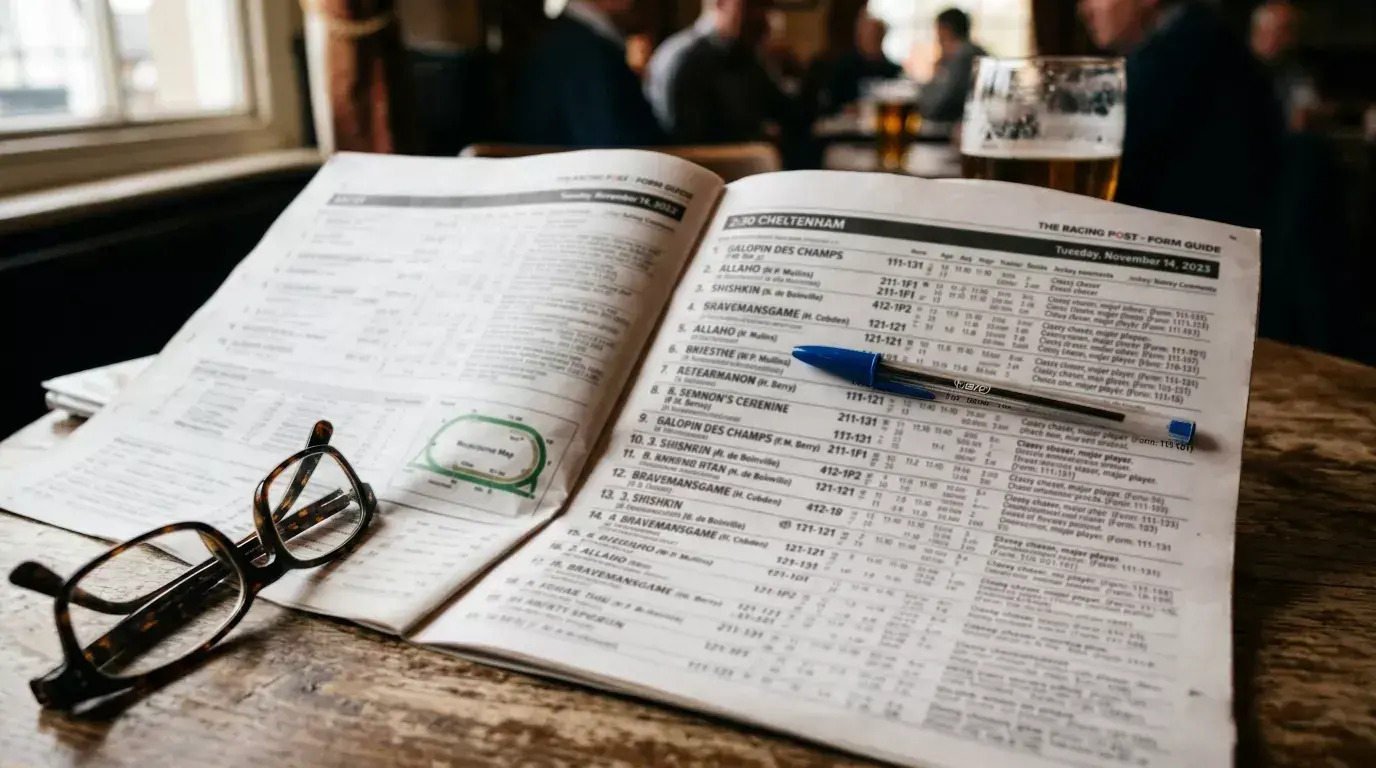
Form Is the Language of Horse Racing — Here Is How to Decode It
A few years into my career I sat next to a veteran punter at Newbury who could glance at a racecard for fifteen seconds and tell you which horse was overpriced. No calculator, no spreadsheet, just decades of reading form until the patterns became instinct. I am not at that level — I still check my numbers — but I understand now what he was doing. He was reading the story each horse’s form told, and the story was more useful than any tip or rating.
Form is the record of everything a horse has done on the racecourse. It tells you where it finished, what distance it ran, what ground it ran on, who trained it, who rode it and whether it wore blinkers. The number of horses in training across the UK fell to 21,728 in 2025, a 2.3% drop from the year before. That shrinking population means smaller fields in many races, which changes how form data plays out — but the language of form itself has not changed in decades.
You do not need to memorise every symbol to make useful betting decisions. What you need is a framework: a short list of the most important form elements and a method for reading them quickly. That is what this guide provides.
Form Figures Decoded: What 1-3-0-P-F-U Actually Mean
Open any racecard and the first thing you see next to a horse’s name is a string of numbers and letters. Something like 213-041. That string is the horse’s form, reading from left to right with the most recent run on the far right. Here is what each character means.
A number from 1 to 9 indicates the finishing position. “1” means the horse won. “2” means second. And so on up to “9” which means ninth. “0” means the horse finished tenth or worse — outside the first nine. The dash separates different racing seasons, so you can see at a glance how many runs the horse has had this season versus last.
Letters carry specific meanings. “P” means the horse pulled up — the jockey stopped riding before the finish, usually because the horse was struggling or had no chance of competing. “F” means fell. “U” means unseated the rider. “R” means refused a fence or hurdle. “B” means brought down by another horse. “S” means slipped up on the flat. “C” means carried out — forced off course by another runner.
A slash (/) indicates a gap of more than one year between runs. If you see something like 1/2-31, the horse won its last start before a lengthy absence, came back and ran second, then won, ran third and won again. That slash is a warning flag: a horse returning from a long break may not be at its previous level, or it may be fully recovered and ready to run a big race. The context matters.
Bold or underlined figures on some form guides indicate a win at today’s course or distance. That brings us to the symbols.
Course and Distance, Class, Weight and Headgear Symbols
Beyond the form figures, racecards are loaded with additional data points. UK racecourse attendance exceeded 5.031 million in 2025, and many of those racegoers pick up a printed racecard at the track that uses the same abbreviation system as the online versions. Knowing these symbols saves you the confusion of guessing what they mean under pressure.
“C” next to a horse’s name means it has won at this course before. “D” means it has won over this distance before. “CD” means both. Course and distance winners have a statistically better record than horses without either flag, for an obvious reason: the horse has proven it handles the specific track layout and trip length. In my analysis, CD horses in handicaps outperform their odds on aggregate — not dramatically, but consistently enough to be a positive filter.
“BF” means beaten favourite — the horse was the market leader last time and lost. This matters because it tells you the market expected it to win and it did not deliver. Sometimes that reflects bad luck; sometimes it reflects a horse that flatters in the market but does not produce on the track. Richard Wayman, BHA’s Director of Racing, has pointed out that while overall turnover on racing has declined, the appeal of the product depends on the quality of information available to bettors. Form symbols like BF are part of that information infrastructure.
Headgear abbreviations indicate equipment changes. “b” means blinkers. “v” means visor. “t” means tongue tie. “h” means hood. “e/s” means eye shield. First-time headgear — especially first-time blinkers or a first-time tongue tie — is a notable signal. Trainers use these aids to address specific problems: blinkers for horses that hang or lose concentration, tongue ties for horses with breathing issues. First-time blinkers in particular carry a measurable positive impact on performance, especially in handicaps where the horse may have been underperforming its ability.
Weight is shown in stones and pounds. The allocated weight reflects the handicapper’s assessment of the horse’s ability relative to the other runners. Lower weight is theoretically an advantage, but weight only tells part of the story. A horse carrying 8st 10lb with a top jockey is not necessarily disadvantaged compared to a horse carrying 9st 7lb with a less experienced rider. What matters is whether the weight is trending up (the handicapper is raising the mark after good results) or down (the horse is slipping in the ratings after poor form). Horses dropping in the handicap can be approaching their winning mark — the weight at which their ability exceeds what the handicapper thinks they are worth.
Putting Form Into Practice: A Five-Minute Pre-Race Checklist
I use a stripped-down checklist before every race I bet on. It takes about five minutes per race and covers the form elements that, in my experience, filter out the most likely losers without overthinking the process.
Step one: check the going. Eliminate any horse with no form on today’s ground or with form that clearly deteriorates on it. Step two: scan the form figures. Focus on horses with recent runs (within the last 60 days) that include at least one finish in the first four. Discard horses showing a string of 0s, Ps or Fs unless you have a specific reason to forgive them. Step three: look for the C and D flags. A horse that has won at the course and distance has cleared a hurdle that others have not. Step four: check headgear. If a horse is wearing first-time blinkers or a first-time tongue tie, note it as a potential improver. Step five: compare the odds with your assessment. If the horse you like best after steps one through four is available at a price that exceeds what you think its chance is worth, you have a bet.
This is not a foolproof system. Nothing in racing is. But it is a structured way to read a racecard that filters the noise and focuses on the signals that actually predict outcomes. The more races you apply it to, the faster it becomes — and the more your instinct starts to match what the form is telling you.
