

Horse Racing Is the UK’s Second-Largest Spectator Sport — and a Billion-Pound Industry
Most punters — myself included, for the first few years — think of horse racing primarily as a betting medium. You study the form, place a bet, watch the race. What I did not appreciate until I started digging into the industry data was the scale of the economic machinery that sits behind every race. The British Horseracing Authority’s submission to the Gambling Act Review put the numbers plainly: horse racing generates direct revenues exceeding 1.47 billion pounds annually and makes a total contribution to the UK economy of 4.1 billion when induced effects are included. That figure encompasses everything from stable staff wages in Lambourn to racecourse hospitality revenue in York to the betting levy that funds the entire sport.
The UK’s regulated gambling industry produced 16.8 billion pounds in gross gaming yield in the year to March 2025, and horse racing’s share of that — while smaller than football or casino gaming — is uniquely integrated into the broader economy. No other sport has a statutory levy that ties betting revenue directly to the sport’s funding. No other sport employs 85,000 people across a supply chain that stretches from breeding farms to betting shops. The economics of racing are distinctive, and understanding them gives you a different perspective on the bets you place.
Direct Revenue, Induced Effects and the 4.1 Billion Pound Figure
The 4.1 billion figure breaks down into three layers. Direct revenue — the money generated by the racing industry itself — accounts for the 1.47 billion. That includes racecourse gate receipts and hospitality, media rights, prize money funded by owners’ entry fees, sponsorship and the commercial operations of training yards and breeding operations.
Indirect effects add the spending by racing’s suppliers: feed companies, veterinary practices, transport firms, equine equipment manufacturers and the construction and maintenance of racecourse facilities. When a trainer orders hay for 40 horses, the feed supplier employs drivers, the farm employs workers and the supply chain extends deep into rural economies that have few other major employers.
Induced effects capture the spending by racing’s employees and participants in the wider economy. Stable staff spend their wages locally. Racegoers spend on travel, accommodation and dining. Owners spend on training fees that flow through to farriers, vets, jockeys and work riders. The BHA’s economic modelling estimates that for every pound of direct revenue racing generates, a further 1.79 pounds of economic activity is induced in the surrounding economy.
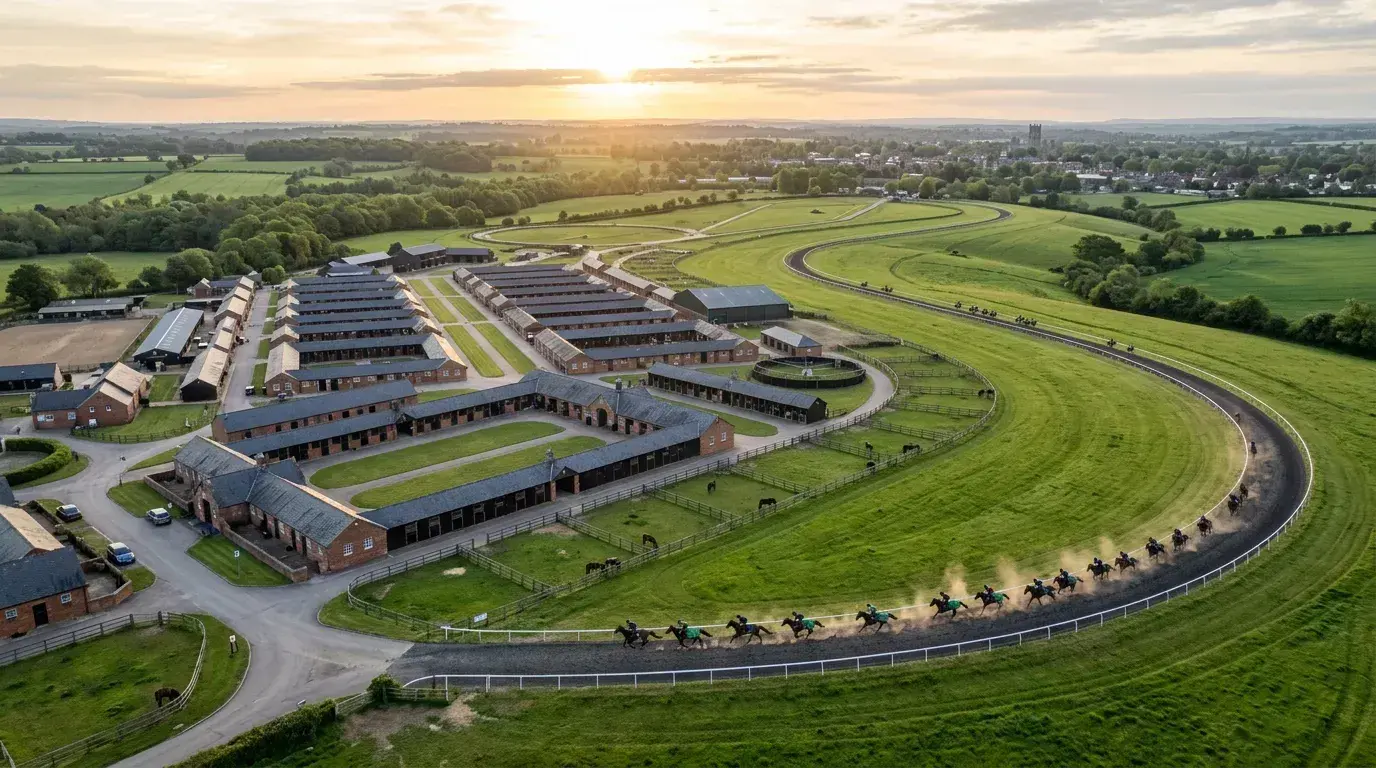
These numbers are not abstract. They show up in the economies of specific towns and regions. Newmarket, Lambourn, Middleham, Malton — these are communities built around training yards where racing is the primary employer and economic driver. A contraction in racing’s finances hits these places harder than it hits the national economy, because there is no alternative employer of equivalent scale waiting to absorb the workforce.
From Stables to Screens: 85,000 Jobs Across the Racing Ecosystem
The 85,000 jobs figure covers a remarkably diverse ecosystem. At the core are the training yards: stable staff (the largest single employment category), trainers, jockeys, work riders and yard management. The number of horses in training fell to 21,728 in 2025, a 2.3% decline, and each horse in training supports roughly one full-time-equivalent job in the yard alone. As the horse population shrinks, so does the direct employment base.
Racecourses employ thousands of people across event management, hospitality, groundskeeping, administration and security. With attendance exceeding 5.031 million in 2025, the operational demands of staging over 1,500 fixtures a year are substantial. Many racecourse jobs are seasonal or part-time, tied to the racing calendar, which makes them particularly important in rural areas where year-round employment options are limited.
The betting sector accounts for another large employment block. The 5,825 licensed betting shops still operating in the UK employ staff directly, and the online operators employ customer service, compliance, trading and marketing teams. Gráinne Hurst of the Betting and Gaming Council has emphasised that regulated betting provides growing long-term investment to the sport — and that investment supports employment both within the betting companies and across the racing industry they fund through the levy.
Breeding and bloodstock is the less visible but economically significant third pillar. The UK and Ireland together form the largest thoroughbred breeding industry in Europe, and British racing’s quality and prize money levels are what sustain the demand for racehorses bred in these islands. The bloodstock sales at Tattersalls in Newmarket and Goffs in Ireland generate hundreds of millions of pounds annually, and the prices paid for yearlings reflect confidence in the future of racing as a commercial enterprise. When that confidence wavers — when prize money stagnates, betting turnover declines or regulatory uncertainty increases — the bloodstock market cools, and the ripple effects reach every breeding farm in the country.
The independent modelling that informed the 2027 tax reform estimated that a unified 21% tax rate on remote betting could have cost 2,752 jobs across the racing ecosystem — a number that illustrates how sensitive employment is to changes in the financial framework.
For punters, the relevance is this: every bet you place on British racing contributes, through the levy, to an economic system that supports tens of thousands of livelihoods. The decline in betting turnover is not just a data point in an analyst’s report — it is a financial pressure that flows through to prize money, employment and the long-term viability of the communities that depend on the sport.
