

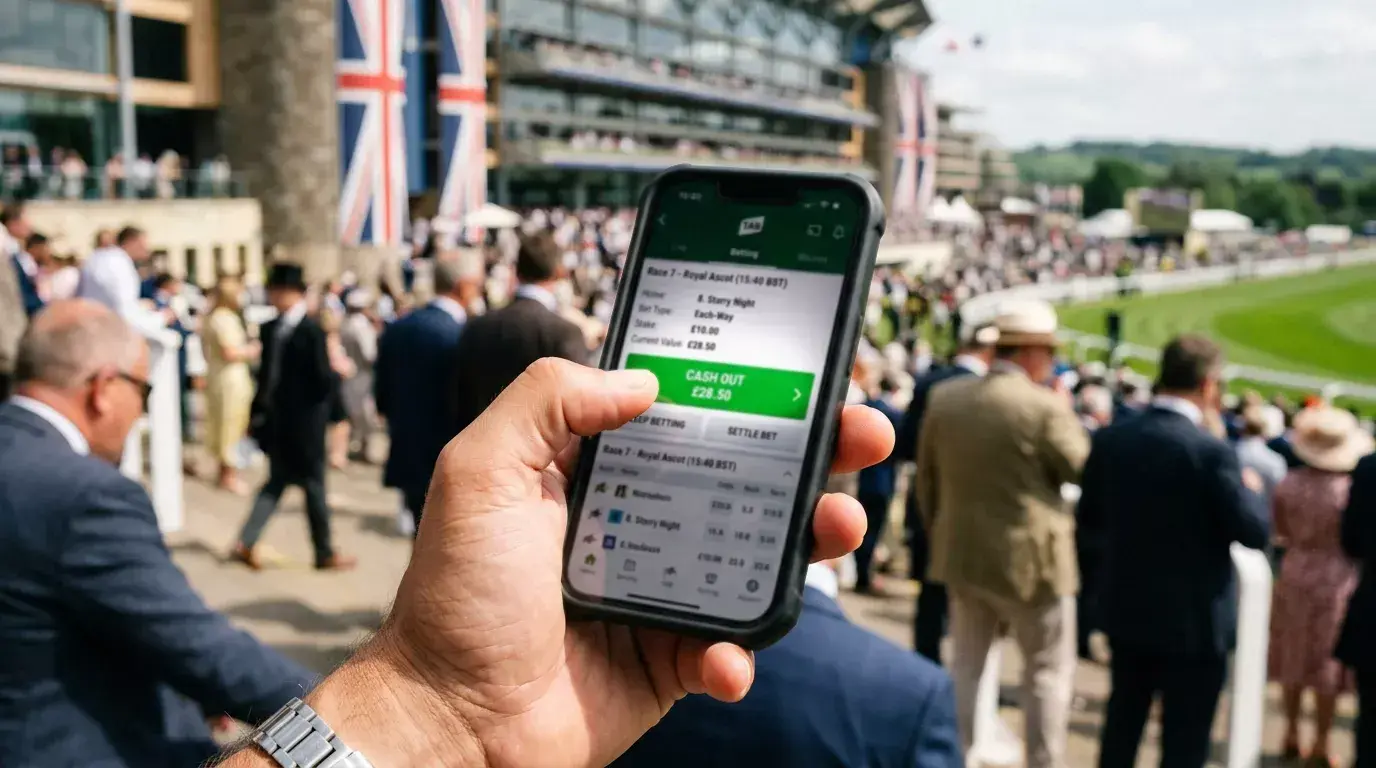
Cash Out Mechanics: Settlement Value and Bookmaker Margins
I was watching a three-mile hurdle at Sandown when my horse hit the front turning for home. The cash-out button on my phone showed a profit of 85 pounds. I hesitated. The horse stumbled at the second-last hurdle, lost momentum and got caught on the line. The cash-out offer vanished the moment the market suspended. I collected nothing. That experience taught me two things: cash out is a genuinely useful tool, and the window for using it is smaller than you think.
Cash out allows you to settle a bet before the event is over, taking either a guaranteed profit or a reduced loss based on how the market has moved since you placed your bet. Online betting generated 7.8 billion pounds in gross gaming yield in the year to March 2025, and cash out has become one of the most popular features across major operators. It is available on most pre-race horse racing markets and, to varying degrees, in-play.
The concept is simple: the bookmaker offers you a price to close your bet early. If your horse’s price has shortened since you backed it — meaning the market thinks it is more likely to win now than when you placed the bet — the cash-out offer will be higher than your stake. If the price has drifted, the offer will be lower. The bookmaker is essentially giving you the option to sell your bet back at the current market value, minus a margin.
How Cash Out Is Calculated: The In-Play Odds Factor
Cash-out offers are not arbitrary. They are calculated from the current odds on your selection, adjusted for the bookmaker’s margin. The basic formula is: cash-out value = (original odds / current odds) x stake, minus the bookmaker’s cut.
Say you backed a horse at 10/1 for ten pounds. The potential return is 110 pounds. Before the race, the horse shortens to 4/1. The theoretical cash-out value is (11.0 / 5.0) x 10 = 22 pounds. The bookmaker takes a margin — typically 5-10% — so the actual offer might be around 20 pounds. You profit ten pounds without the race being run. If the horse drifts to 20/1 instead, the cash-out value drops: (11.0 / 21.0) x 10 = roughly 5.24 pounds, minus margin. You would cash out at a loss.
In-play, the calculation becomes more dynamic because the odds shift with every furlong of the race. A horse leading at the two-furlong pole will have much shorter in-play odds than a horse sitting last. The cash-out offer updates in real time — or close to it — but there is always a lag between what you see and what the operator’s algorithm is pricing. Remote horse racing betting generated 766.7 million pounds in GGY in FY2024-25, and in-play cash out is a meaningful contributor to that figure because it keeps punters engaged throughout the race.
The margin the bookmaker takes on cash out is where the feature stops being neutral and starts working against you. Over time, if you cash out every bet, you will surrender more in margin than you would by simply letting bets run. Cash out is best used selectively — when the situation has genuinely changed and your pre-race assessment no longer holds — rather than as a default response to short-term market movements.
Partial Cash Out and Auto Cash Out: When to Use Each
Partial cash out lets you settle a portion of your bet while leaving the rest to run. If the cash-out offer on your ten-pound bet is 50 pounds, you might cash out half — taking 25 pounds in guaranteed profit — and leave the remaining five-pound equivalent riding on the original outcome. If the horse wins, you collect the remaining payout on the portion still active. If it loses, you keep the 25 pounds.
I use partial cash out more than full cash out. It solves the psychological problem of leaving money on the table while still maintaining a position if things go well. The maths is straightforward: you are splitting your bet into two independent parts, one settled and one live. The margin the bookmaker takes applies to the settled portion; the live portion runs at the original terms.
Auto cash out is a feature where you set a target cash-out value and the operator automatically settles your bet if that value is reached. Set it at 50 pounds on a bet with a potential return of 110, and the operator executes the cash out the moment the offer hits 50 — even if you are not watching. This is useful for bets on meetings you cannot follow live, but it comes with a caveat: the trigger is based on the operator’s offered price, not the theoretical fair value. The margin is baked in, and you may find the auto cash out triggering at a moment when letting the bet run would have been more profitable.
My general guidance: use full cash out only when your view has changed and you would not place the bet again at the current odds. Use partial cash out when you want to de-risk without fully exiting. Use auto cash out sparingly — it removes your judgment from the decision at the exact point where judgment matters most. And always remember that the exchange alternative to cash out — laying your selection on a betting exchange to lock in profit — often offers a tighter margin than the bookmaker’s cash-out price.
Cash Out Pitfalls: Suspended Markets and Price Gaps
The biggest practical problem with cash out is market suspension. During a horse race, the in-play market can be suspended at any time — typically when there is a significant incident (a faller, a horse making a move, the field bunching at a fence). When the market is suspended, cash out is unavailable. The offer disappears from your screen. By the time the market reopens, the odds may have shifted dramatically, and the cash-out offer may be completely different from what it was seconds earlier.
I have experienced this repeatedly in jump racing, where falls and errors cause frequent suspensions. You see your horse travelling well, the cash out looks attractive, you reach for the button — and it is gone. The race resumes, the horse makes a mistake, and the cash-out offer drops by 80%. The lesson: if you intend to cash out during a race, do it early. Do not wait for the optimal moment, because the optimal moment is often the moment the market suspends.
Price gaps between the displayed offer and the executed offer are another pitfall. In fast-moving markets, the cash-out value shown on your screen may change between the moment you tap the button and the moment the operator processes the request. Most operators include a “confirm at new value” step if the offer has moved, but the speed of horse racing means these changes happen in seconds. If you are cashing out in-play, expect the executed value to differ slightly from the displayed value — and decide in advance whether you are comfortable with that slippage.
