

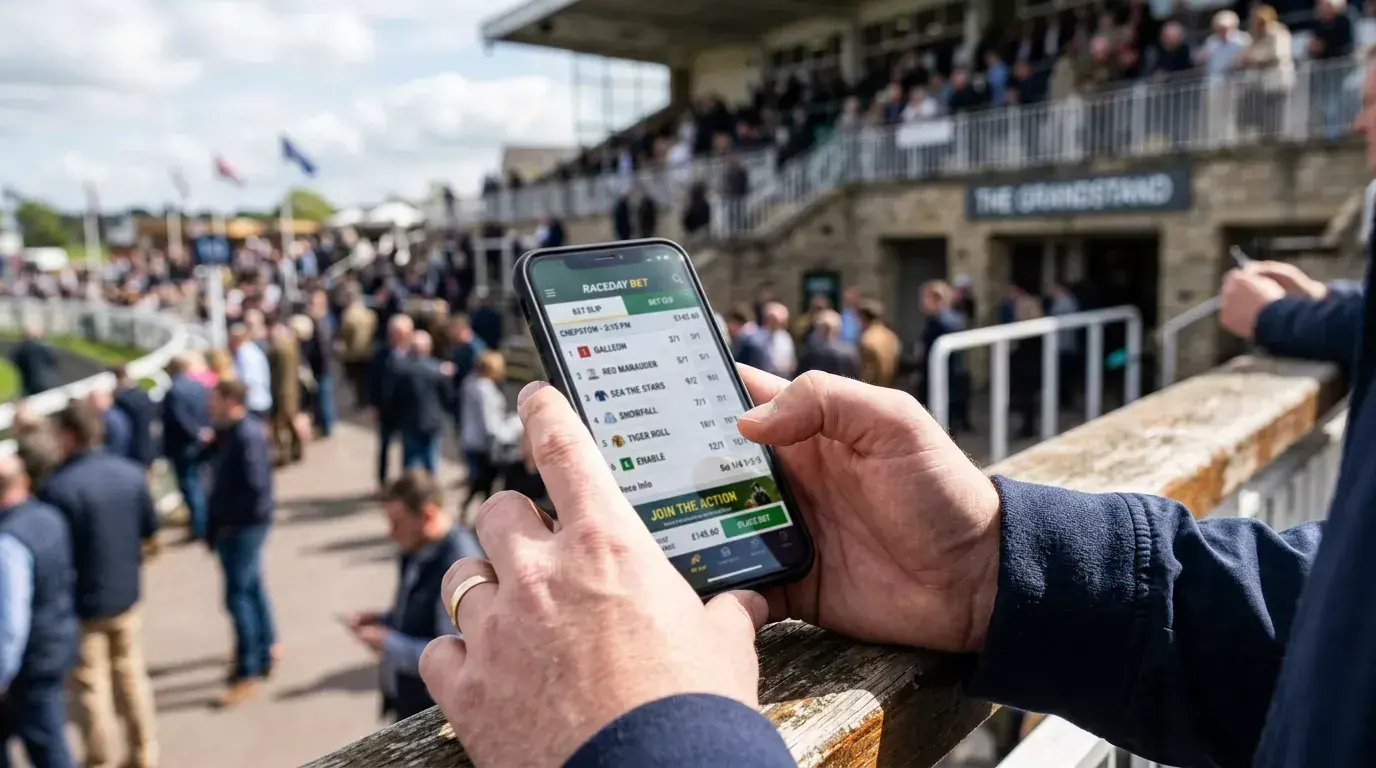
First Bet Process: Account Setup and Racecard Data
I remember my first bet on the horses. A mate handed me a folded-up newspaper at Cheltenham, pointed at something called “form figures” and said “back that one, it’s got a C and a D next to its name.” I had no idea what that meant. I put a tenner on, the horse finished second, and I spent the rest of the afternoon wondering why I got nothing back when it nearly won. Nobody had mentioned each-way betting to me.
That was over nine years ago. Since then I have placed thousands of bets, tracked my results obsessively and built a career around analysing racing markets. And the single biggest lesson from all of it is this: the mechanics of placing a bet are simple, but understanding what you are actually doing with your money matters far more than picking a “winner.” Around 10.3% of UK adults bet on sport and racing online or through apps, and a huge chunk of those people — especially the once-a-year Grand National crowd — go in without knowing the basics.
This guide strips the process down to what you actually need for your first online horse racing bet. Not a glossary of 50 terms you will forget. Not a list of bookmakers with affiliate links. Just the steps, in order, with the context that stops you making the mistakes I made.
If you already know your way around a racecard and want to explore the full range of horse racing bet types, that guide goes deeper. This one is for the person who has never placed a bet and wants to get it right the first time.
Setting Up a Licensed Betting Account in Five Minutes
A friend once told me he had signed up with a site he found through a social media ad — no licence check, no verification, just a deposit page. That is exactly how people end up on unlicensed operators. The number of licensed betting shops in the UK has dropped to 5,825, down 36% in a decade, which means more betting happens online than ever. The operator you choose needs a UK Gambling Commission licence. Full stop.
Here is the actual process. Open the operator’s website or download the app. Look for the UKGC licence number — it is usually in the footer, and you can cross-reference it on the Gambling Commission’s public register. Hit “Register” or “Join.” You will need your full name, date of birth, address, email and a username. Every UKGC-licensed site must verify your identity before you can withdraw, and most now verify before you can even deposit. That means uploading a photo of your passport or driving licence and sometimes a utility bill. It sounds invasive, but it is a legal requirement under Know Your Customer rules.
Once verified, deposit funds. Debit cards are the standard method since credit card gambling was banned in the UK in April 2020. Bank transfer, PayPal and Apple Pay are common alternatives. Set a deposit limit at this stage — every licensed operator must offer this tool, and it is the single most useful responsible gambling feature for a beginner. If you decide your monthly budget is fifty pounds, lock it in. You can always lower the limit instantly, but raising it triggers a cooling-off period.
The whole process takes about five minutes if you have your ID to hand. Do not skip the licence check. Do not skip the deposit limit.
Reading a Racecard: The Minimum You Need to Know
I used to think racecards were deliberately designed to confuse outsiders. Rows of tiny numbers, letters, abbreviations — it looks like a spreadsheet built by someone who hates readability. But once you learn five pieces of information, you can make a reasonable first selection without pretending to be a professional handicapper.
The five things are: the horse’s name, its recent form figures, the trainer, the jockey and the draw (in flat racing). Form figures are the numbers next to the horse’s name — typically the last six results, reading left to right from oldest to most recent. A “1” means it won; a “2” means second; a “0” means it finished outside the top nine. A dash separates different seasons. So a horse showing 31-042 won two starts ago this season, after finishing fourth and then unplaced. The pattern you want for a first bet is simple: look for horses that have recent numbers close to 1.
The trainer and jockey tell you who is responsible for the horse’s preparation and who rides it. At this stage, you do not need to memorise trainer statistics. Just note whether the same jockey who rode the horse last time is riding again — a jockey switch, especially to a higher-profile rider, sometimes signals confidence from the yard.
In flat races, the draw refers to the stall number the horse starts from. At certain courses and over certain distances, low draws or high draws carry a measurable advantage. For your first bet, do not overthink it. But if you hear someone say “drawn one at Chester over six furlongs” and they sound excited, now you know why.
The racecard also shows the going (ground conditions), the distance of the race, and the class. Going matters enormously — a horse that loves firm ground can struggle on soft — but for a beginner’s first bet, the form figures do the heaviest lifting.
Placing Your Bet Online: Walk-Through With Screenshots Logic
The first time I placed an online bet, I accidentally put a fiver on two separate horses in the same race as a double instead of two singles. The interface was not confusing — I just did not understand the difference. So here is the step-by-step logic of what happens when you actually place a bet.
Open the racing section of your betting app or site. You will see a list of today’s meetings — Ascot, Newmarket, Kempton, wherever racing is happening. Tap a meeting, then tap a specific race. The racecard appears. Next to each horse is a price — those are the odds. If you see 5/1, that means five pounds of profit for every one pound you stake, plus your stake back. A horse at 2/1 returns three pounds total on a one-pound bet (two pounds profit plus one pound stake).
Tap the odds next to the horse you want to back. It will appear on your bet slip — usually a panel that slides up from the bottom of the screen or sits on the right side on desktop. The bet slip shows the horse name, the race, the odds and a box for your stake. Type in the amount you want to bet. The slip will calculate your potential return.
Now comes the important decision: what type of bet? For your first bet, stick with a simple “win” bet. Your horse must finish first for you to collect. If you want a little more security, choose “each-way.” An each-way bet is two bets in one — a bet on winning and a bet on placing (finishing in the top two, three or four depending on the number of runners). It costs double your unit stake, so a five-pound each-way bet costs ten pounds total. But if your horse finishes in the places without winning, you still get a return.
Confirm the bet. You will see a confirmation screen with a bet reference number. That is it. You have placed your first horse racing bet. Now watch the race — and whatever happens, do not chase the result with a bigger bet five minutes later. Set a session budget, stick to it and treat the first few bets as tuition, not income.
One final thing: the odds you took might differ from the starting price — the final price determined on course moments before the off. Most major operators offer Best Odds Guaranteed on UK and Irish races, meaning if the starting price is higher than the price you took, they pay you the better price. It is one of the few features that works in the punter’s favour, and it is worth confirming your operator offers it before you bet.
