

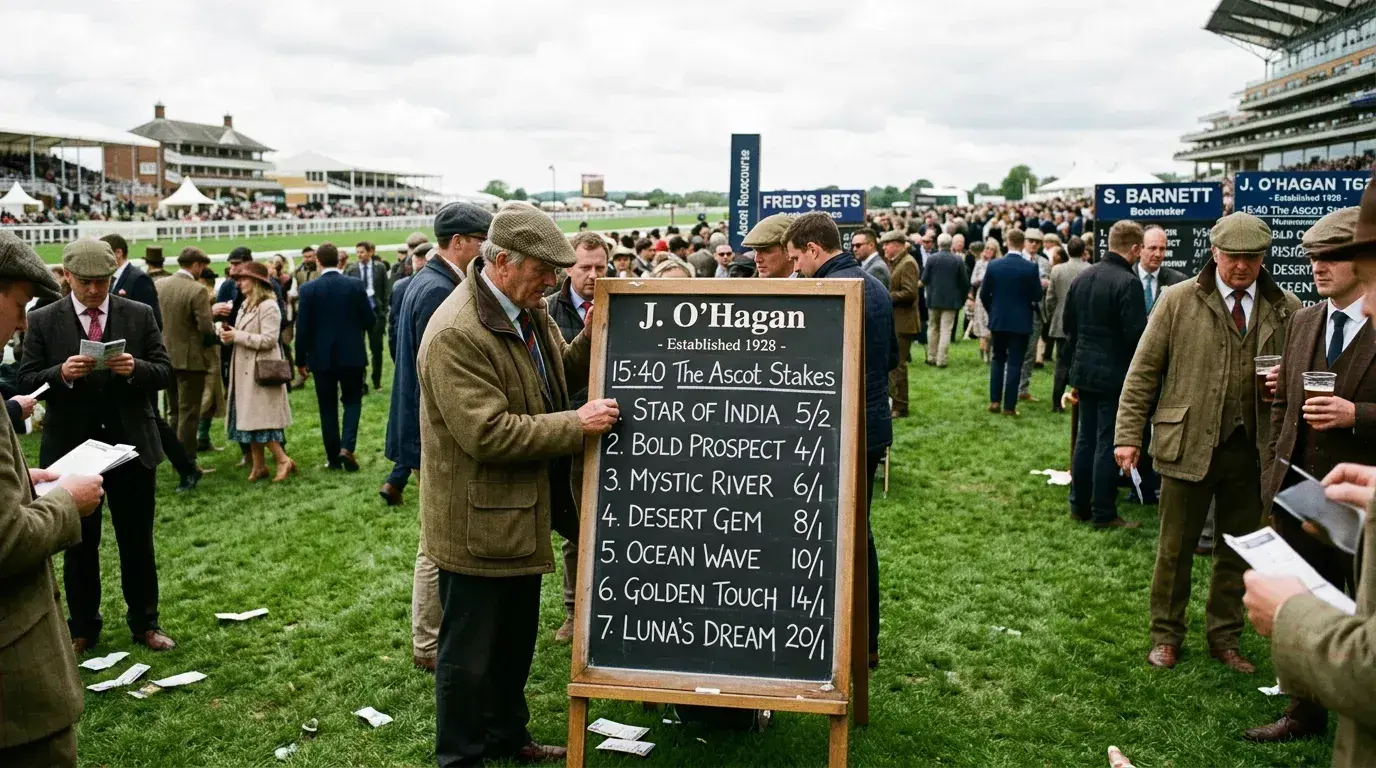
BOG Mechanics: Starting Price Fluctuation and Limits
I have a rule I give to every punter who asks me where to start: before you compare welcome offers, before you look at the app design, before you check whether they stream Irish racing — ask one question. Does this bookmaker offer Best Odds Guaranteed on UK and Irish horse racing? If the answer is no, move on.
BOG is the single feature that transfers value from the bookmaker to the punter with no additional risk attached. You take a price in the morning. If the Starting Price is higher when the race goes off, you get paid at the higher price. If the SP is lower, you keep your original price. It is a one-way ratchet in your favour, and over a season of 300 or more bets it adds a measurable percentage to your return that no amount of “free bet” promotions can replicate.
Remote horse racing betting generated £766.7 million in gross gaming yield in the 2024-25 financial year. A meaningful portion of that revenue comes from the gap between the price a punter takes early and the price the horse goes off at. BOG closes that gap on the upside while leaving it open on the downside. It is, in effect, a free option — and in my nine years of analysing racing markets, I have never found a second feature that comes close to its impact on long-term profitability.
What follows is a full breakdown: how the mechanism works, what limits apply, how Starting Price is actually formed, and where BOG creates its biggest payoffs. I will also compare the BOG model with exchange pricing, because the two approaches overlap in ways that most punters have not considered.
How Best Odds Guaranteed Works: Early Price, SP and the Payout
The mechanics are simple enough to explain in three sentences. You place your bet at whatever odds the bookmaker is offering at that moment — these are called early prices or board prices. The Starting Price is then determined just before the race begins, based on on-course betting activity. If the SP is higher than the price you took, your bet is settled at the SP; if it is lower, your bet is settled at your original price.
In practice, this plays out hundreds of times a week. A horse is priced at 8/1 on Monday morning for a Wednesday race. By the time the race starts, market support from other punters has pushed the price down to 6/1. Under BOG, you keep your 8/1. Your mate backs the same horse ten minutes before the off at the now-available 6/1. He gets 6/1. You both backed the winner, but you earned 33% more profit per pound staked. That is the downside protection: BOG never hurts you when the price shortens.
Now the upside. Suppose instead that the horse drifts. It was 8/1 on Monday, but by Wednesday there is money for other runners and the SP settles at 11/1. Under BOG, your bet is settled at 11/1 — the higher price — even though you took 8/1 two days earlier. On a £20 win stake, that is £220 versus £160. Sixty pounds of additional profit, generated by a market movement you had no control over, at zero extra cost.
Most bookmakers apply BOG automatically to qualifying bets. You do not need to opt in, tick a box, or mention it at the time of placing. The settlement simply reflects the higher of the two prices. However, the word “qualifying” matters. Not all bets qualify, not all races qualify, and not all stakes qualify. I will deal with those restrictions in a later section, because they are more significant than the marketing suggests.
One further point: BOG applies to both the win and place parts of an each-way bet. If you back a horse at 10/1 each-way and the SP is 14/1, the win part is settled at 14/1 and the place part is calculated from 14/1 rather than 10/1. At 1/5 place terms, the place payout jumps from 10/5 = 2/1 to 14/5 = 2.8/1. That is a meaningful uplift on the place part that most each-way punters never consciously register. Understanding this interaction is one of the reasons I wrote a detailed companion piece on ante-post betting rules and pricing, where the BOG question becomes even more relevant.
Worked Example: A £20 Bet With and Without BOG
Numbers always clarify what prose obscures. Let me walk through a single bet — a £20 win stake on a horse in a Saturday handicap — under three different price scenarios, with and without BOG.
You back the horse on Thursday evening at 10/1. The race is on Saturday afternoon.
Scenario A: SP is lower than your price — 7/1
Without BOG, your bet stands at 10/1 regardless (you locked in the price). With BOG, your bet also stands at 10/1 — the higher of the two. In this case BOG makes no difference, but you have protected your position. Payout either way: £200 profit + £20 stake = £220.
Scenario B: SP matches your price — 10/1
No difference with or without BOG. Payout: £220. This scenario is the least interesting but the most common — roughly a third of my bets settle at or very close to the price I took.
Scenario C: SP is higher than your price — 14/1
Without BOG: settled at 10/1. Payout: £220. With BOG: settled at 14/1. Payout: £280 profit + £20 stake = £300. Difference: £80. On a single £20 bet. That £80 is pure additional profit for which you paid nothing and risked nothing. If this scenario occurs on just 15% of your winning bets across a season — and in my records it occurs more often than that — the cumulative impact runs into hundreds of pounds.
To put it in broader terms: if you place 300 bets across a season at an average stake of £15, and your strike rate is 20%, that gives you 60 winners. If BOG adds an average of £12 of additional profit to the 15% of winners where the SP exceeds your price, you gain 60 x 0.15 x £12 = £108 over the season. That is £108 of free money, enough to fund seven or eight additional bets at your standard stake. Over five years, compounded through reinvestment, it fundamentally changes the trajectory of a bankroll.
Understanding how starting prices fluctuate requires a solid grasp of how fractional and decimal horse racing odds represent implied probability.
BOG Restrictions: Caps, Qualifying Races and Exclusions
Here is where the marketing and the reality diverge. Every bookmaker offering BOG attaches conditions, and those conditions vary enough between operators to make a meaningful difference to your bottom line.
Maximum payout caps are the most common restriction. A bookmaker might advertise BOG on all UK and Irish racing but cap the maximum additional profit at £500 or £1,000. If you take 10/1 on a £100 stake and the SP drifts to 25/1, your uncapped BOG profit would be an extra £1,500. Under a £500 cap, you receive only £500 of that drift. For stakes under £20 this rarely matters. For serious punters betting at higher stakes, the cap can negate a large portion of the BOG benefit.
Race eligibility varies. Most BOG offers cover UK and Irish racing only. International meetings — France, the US, Australia, the Gulf — are typically excluded. Some operators also exclude specific meeting types: all-weather racing, amateur riders’ races, or races with fewer than a certain number of declared runners. I always check the terms for the specific meeting before assuming BOG applies.
Time restrictions are subtler. Some bookmakers only guarantee odds taken from a certain time onwards — say, from 9am on the day of the race, or from when early prices are first published. Bets placed the night before, or on ante-post markets, may not qualify. This creates a tension between getting the best early price and qualifying for BOG, and the answer is not always obvious. In my experience, the early-morning window (between 8am and 10am on race day) tends to offer both reasonable prices and BOG eligibility on most major operators.
Finally, enhanced odds promotions and price boosts usually sit outside BOG terms. If you take an enhanced price of 12/1 on a horse whose standard price is 8/1, and the SP is 10/1, the bookmaker will not settle at the higher SP because the enhanced price already exceeded it. These promotions are separate from BOG, and mixing them up is a surprisingly common error.
The bottom line: BOG is a genuine structural advantage, but only when you use it within the qualifying parameters. I make a point of reviewing the BOG terms for each bookmaker I use at the start of every season. Terms change — what qualified last year may not qualify this year, and new restrictions can appear without fanfare. Ten minutes of reading the small print once a season protects thousands of pounds of potential value across the year.
Starting Price Explained: How SP Is Calculated on Course
To understand BOG properly you need to understand how the Starting Price is formed, because the SP is the benchmark against which your early price is measured. Most punters think the SP is set by bookmakers. It is not. The SP is determined by an independent organisation based on the prices available in the on-course betting ring at the moment the race starts.
Starting Price reporters attend every UK race meeting. Their job is to record the odds being offered by on-course bookmakers in the moments before the “off.” The SP is then calculated as a median or representative price across those on-course markets. It reflects the balance of supply and demand among the racegoers actually present at the track, not the online market. This distinction matters because on-course and online markets can diverge significantly, particularly in the final minutes before a race.
The SP tends to be most volatile in big-field handicaps, where late money from on-course punters can push a horse in from 14/1 to 10/1 in the last two minutes, or let it drift from 8/1 to 12/1. Total betting turnover per race dropped 8% year-on-year in the 2024-25 financial year, and the decline was steeper on Core Fixtures — the everyday meetings outside the headline festival days. Less on-course turnover means thinner on-course markets, which means more volatile SPs. Paradoxically, the shrinking of the on-course market makes BOG more valuable, because larger SP swings create bigger potential payouts under the guarantee.
There is one practical implication that experienced punters exploit. If you can identify races where the on-course market is likely to push the SP higher — typically because the race has attracted a strong favourite whose price will shorten, causing the other prices to drift outward — taking an early price on an outsider with BOG becomes a strategically sound move. You lock in a price you consider fair, and if the favourite takes late support on course, your horse’s SP drifts, and BOG hands you the better number. It is not guaranteed, but the asymmetry is always in your favour: you gain on the drift and lose nothing on the contraction.
One further wrinkle: the SP does not always align neatly with the exchange price at the off. On-course bookmakers and online exchange users are different populations with different motivations. On-course layers factor in their own liabilities; exchange users react to real-time information flow. I have seen cases where the exchange price at the off was 8/1 but the official SP was 10/1, simply because on-course money was thinner and the few remaining layers pitched their prices wider. In those cases, a BOG bettor who took 7/1 early collected at 10/1 — a better outcome than the exchange user who waited for the sharpest possible price.
BOG at Bookmakers Versus Exchange Prices
Betting exchanges operate on an entirely different pricing model, and comparing them with BOG-backed bookmaker bets requires understanding what each actually delivers. On an exchange, there is no fixed price and no Starting Price — you back at whatever odds another user is willing to offer, and the price fluctuates continuously until the race starts and through in-play trading.
The theoretical advantage of exchanges is that their prices are often slightly larger than the equivalent bookmaker price, because there is no overround built in. Instead, the exchange takes a commission — typically 2% to 5% — on your net winnings. Gross gaming yield from on-course betting has been declining steadily: the broader retail betting sector generated £2.5 billion in GGY in 2023-24, down from £3.3 billion in 2015-16, while online channels grew from £1.7 billion to £2.4 billion over the same period. Part of that online growth includes exchange activity, though exchanges remain a minority of total turnover.
The comparison with BOG becomes interesting when you consider price certainty. On an exchange, you can request a price and wait for it to be matched. If 12/1 becomes available, you take it. But you cannot lock in 10/1 on Monday and receive 14/1 on Wednesday if the price drifts — the exchange simply offers you whatever the current price is at the moment you bet. BOG, by contrast, gives you that upside drift automatically. You take 10/1 on Monday, and if the SP is 14/1 on race day, you collect at 14/1. The exchange user who took 10/1 on Monday gets 10/1.
Gráinne Hurst, CEO of the Betting and Gaming Council, has pointed to the paradox of record levy contributions coexisting with declining turnover — she noted that “despite record levy contributions, racing continues to struggle, both as a sport and as a betting product.” For the individual punter, the BOG-versus-exchange question is simpler than the industry-wide picture. BOG is a free asymmetric option that costs nothing to access. Exchange prices are generally sharper but lack the upside protection. If you are betting at 10/1 or longer in races where you expect late SP drift, BOG at a bookmaker frequently outperforms the exchange price. At shorter prices in efficient markets, the exchange’s tighter margin may be the better value. I use both, depending on the race.
Stay ahead of the bookmakers by utilizing the expert analysis provided by the leading UK racing data hub.
When BOG Adds Real Value: Handicaps, Big Fields, Festival Races
BOG delivers its greatest value in specific conditions, and recognising those conditions separates the punters who benefit from the feature from the ones who carry it as a dormant insurance policy they never cash.
Big-field handicaps at festival meetings are the prime territory. The Grand National generates roughly £250 million in total betting turnover, with a 40-runner field where prices routinely swing by several points between early morning and the off. A horse priced at 20/1 on the morning of the race can drift to 28/1 or contract to 14/1 depending on late market activity. With BOG, you capture the full drift with no downside. Without BOG, you are stuck at whatever price you locked in. The sheer size of the Grand National field amplifies the SP volatility that makes BOG profitable.
Races where a well-backed favourite dominates the late market also create BOG opportunities. If a 2/1 shot attracts heavy late support on course, pushing it to 6/4, the prices of every other horse in the race drift outward to maintain the book. A 10/1 shot might drift to 12/1 or 14/1 at SP. If you took the 10/1 in the morning with BOG, you collect at the higher SP. This is predictable in certain race types — championship races with a dominant contender, two-year-old maidens with a heavily hyped debutant — and building it into your race selection adds a layer of passive value to your approach.
Conversely, BOG adds little value in races with small fields and stable markets. A four-runner novice chase at Plumpton on a Monday afternoon is unlikely to see meaningful SP drift, because the market is already thin and the prices are well-established. Betting with BOG in these races is not harmful — it costs nothing — but expecting it to enhance your return is unrealistic.
Seasonal patterns matter too. The flat season’s big handicaps — from the Lincoln in late March through the Cambridgeshire in early October — generate the largest fields and the most volatile SPs. The jumps season’s premier fixtures at Cheltenham, Aintree and the Christmas meetings offer similar opportunities. Between those peaks, BOG’s marginal impact diminishes. I think of BOG as a seasonal amplifier: it magnifies returns during the periods when the market is most active and most prone to late price movements, and sits dormant during the quieter stretches where the prices barely move.
