

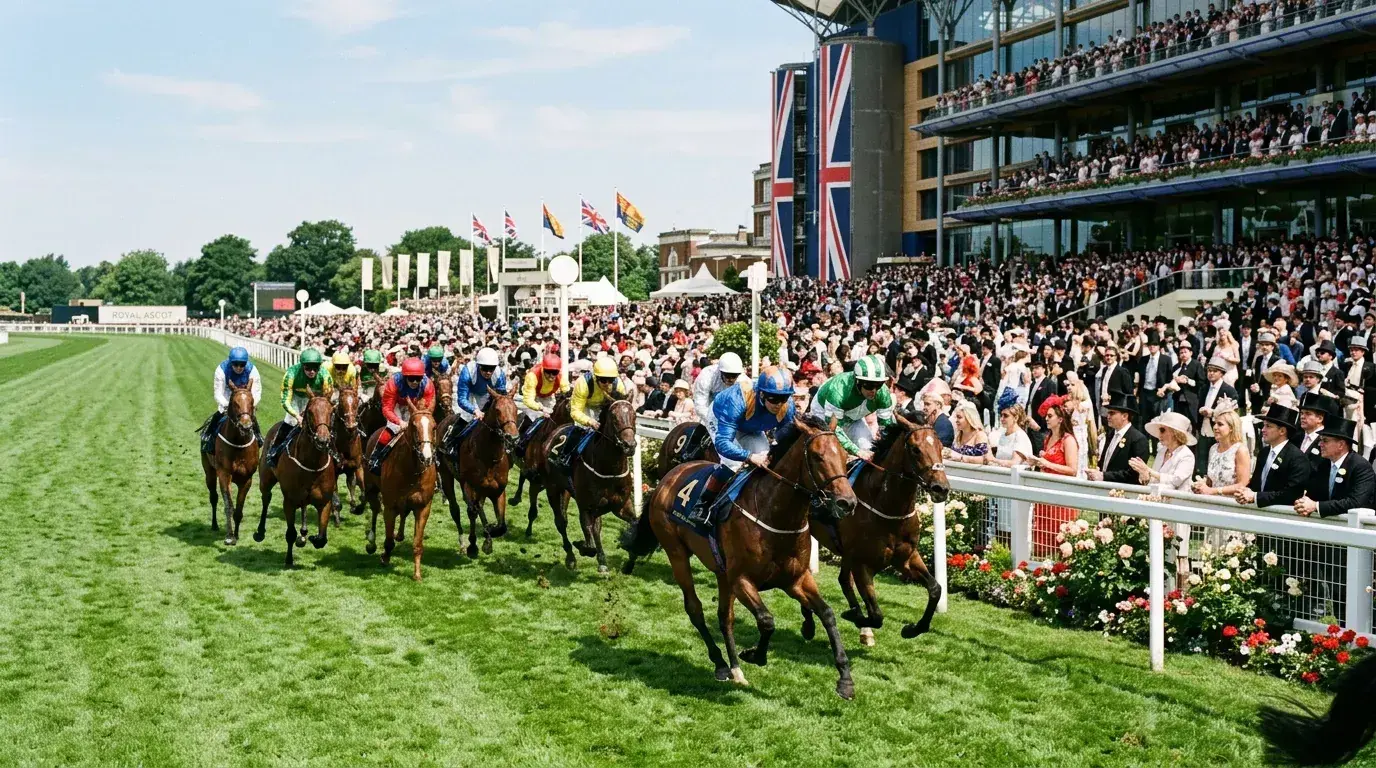
Flat Racing’s Flagship Festival: Why Ascot Stands Apart for Bettors
Royal Ascot is the week when flat racing announces itself. I have been attending — and betting on — the meeting since my first year as an analyst, and the thing that always strikes me is how different the betting landscape feels compared to the jumps festivals. The crowds are enormous, the international runners add layers of form complexity you do not get at a standard UK meeting, and the sheer quality of the racing compresses the odds in ways that make finding value a genuine challenge.
UK racecourse attendance exceeded 5.031 million in 2025, the first time the figure topped five million since 2019, and Royal Ascot accounts for a disproportionate share. Across five days of racing — Tuesday through Saturday — the meeting draws over 300,000 racegoers, many of whom are there for the spectacle rather than the betting. But behind the top hats and the dress code, the markets are fiercely competitive. Betting participation in horse racing peaks during the spring and summer season, with surveys showing 7% participation in the April-to-July window versus 4% in other periods. Royal Ascot sits right in the heart of that peak, which means liquidity is high, markets are well-formed and lazy prices are rare.
That is what makes Ascot both exciting and demanding for punters. The opportunities are there — but they require more preparation than most UK meetings.
Gold Cup Day, King’s Stand and the Hunt for Handicap Value
I once backed what I thought was a certainty in the Gold Cup at 5/4. It finished fourth. The horse that beat it had shipped over from France, had form I had not properly assessed and won going away. That experience cured me of treating Ascot’s feature races as foregone conclusions.
The Gold Cup, run over two miles and four furlongs on the Thursday, is the centrepiece of the week but not always the best race for punters. It tends to attract a small, select field of proven stayers, which means short prices and less room for value. The favourite has a reasonable record, but at the prices typically available — often odds-on or thereabouts — the return rarely justifies the risk unless you are operating within a wider portfolio of bets.
The King’s Stand Stakes on the opening Tuesday is a different proposition. Five furlongs, often a large field by Group 1 standards, and wide open. Sprint races at this level are harder to predict because the margins are tiny and the draw can play a decisive role. That unpredictability is exactly where value lives — horses at 10/1 or 14/1 in the King’s Stand are live contenders in a way that a 14/1 shot in the Gold Cup usually is not.
But the real opportunities at Royal Ascot sit in the handicaps. The Royal Hunt Cup, the Wokingham Stakes, the Britannia Stakes — these are the races that attract fields of 20 or more runners, where form is compressed by the handicap system and the draw, the going and the pace of the race all play measurable roles. I spend more time preparing for the Wokingham than for the Gold Cup, because the Wokingham’s big field and wide-open nature is where my analysis has the best chance of surfacing an edge the market has missed.
Big Fields, Draw Bias and Going: Ascot-Specific Factors
BHA data shows that the number of horses in training fell to 21,728 in 2025, continuing a multi-year decline. That trend means smaller field sizes across UK racing as a whole — but Royal Ascot largely defies it. The prize money and prestige attract maximum entries, and the handicaps routinely go off with 20-plus runners. Big fields at Ascot create specific dynamics that do not apply at smaller meetings.
The draw is the most discussed of those dynamics, and for good reason. Ascot’s straight course — used for races at five, six and seven furlongs as well as the mile — has a documented bias that shifts depending on the going. On soft ground, the far side (high draws) tends to hold an advantage because the ground closest to the stands rail gets chewed up first. On good to firm ground, the bias is less pronounced but still favours certain stall positions depending on the distance. Richard Wayman, the BHA’s Director of Racing, has spoken about the need to improve racing’s appeal as a betting product. Understanding track-specific factors like the Ascot draw is exactly the kind of knowledge that turns racing from a lottery into a skill-based market.
I track draw results at Ascot by distance and going across every meeting, not just Royal Ascot. The data is publicly available through form databases, and the patterns are consistent enough to be useful. In a 30-runner Wokingham on good to soft ground, I will always lean towards horses drawn middle to high unless there is a compelling form reason to override the data. That single filter has improved my Ascot handicap results more than any other factor I have tested.
Going is the other variable that shapes Royal Ascot more than most meetings. June weather in Berkshire is unpredictable, and the ground can shift from good to firm to good to soft within 48 hours if rain arrives. Horses that need fast ground and find themselves on an easing surface are at a genuine disadvantage — and the market does not always adjust quickly enough to reflect it. Checking the going report on race morning and cross-referencing it against each horse’s ground preferences is a ten-minute exercise that can transform your selections.
The combination of draw, going and field size makes Royal Ascot handicaps some of the most data-rich betting puzzles in UK racing. The punters who put in the work before the meeting — building a shortlist filtered by draw, ground and form — consistently outperform those who pick names or follow tips. That has been my experience over nine years, and the numbers back it up.
